Poet, writer, and advocate for wildlife, wild lands, and the earth. President, Forest Voices of India - a U.S.-based group which aids charities in India that further education, culture, the well-being of women, children, and animals, and the restoration of sacred groves.
websites:
https://wordpress.com/view/forestvoicesofindia.com
https://wordpress.com/view/echoesinthemist.com
https://wordpress.com/view/wildvoices.world
book: Glimpses of Kanchi
https://www.amazon.com/Glimpses-Kanchi-Sharon-St-Joan/dp/1982901179/ref=sr_1_1?keywords=Glimpses+of+Kanchi&qid=1581769003&sr=8-1
At around 6am on October 6, Mr. Dawn Williams, General Manager of Blue Cross, took a call from Mrs. Radha Rajan, a good friend of Blue Cross and a courageous animal advocate, about a dog trapped in a crevice. The dog had fallen from a roof and was stuck in between the asbestos walls of two huts. Not well off, the people who lived there couldn’t afford to take down the walls of their house in order to free the dog.
The Blue Cross team arrived on the scene to find a really frightened dog, in a lot of pain and all set to bite anyone who came near. Undeterred, Dawn Williams wrapped his face in a cloth and was lowered down into the crevice head first, by two area residents holding on to his feet. It was a really tight squeeze, and the scared dog did bite just as hard as she could, while she was being rescued.
Once the dog was freed from the crevice, she suddenly realized that she’d been saved, and covered Dawn Williams with kisses in a very affectionate way – maybe partly as an apology for biting him. Both dog and human are safe and sound, and neither was seriously hurt.
This is one of Blue Cross’s many heroic rescues of animals in distress.
If you’d like to read more about Blue Cross’s work or help with a donation, visit their website here.
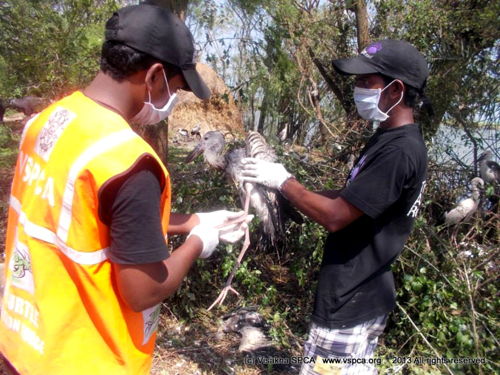
In the Srikakulam district of Andhra Pradesh, hard-hit by the strong winds of cyclone Phaillin, the VSPCA (Visakha Society for Protection and Care of Animals) has been rescuing wild storks.
Around 2,000 Asian openbill storks were found on the ground, having fallen from their nests during the violent storm. Some had died, but many could be rescued, and the VSPCA team was hard at work picking them up, examining them for injuries, treating them, and feeding them.
The VSPCA has helped the storks of this colony for several years, educating the people in how to care for them and keep them safe from poachers. Many of the storks, especially the adults, survived and were still safe in the trees. But it was sad to see so many who had fallen. Their breeding season is from July to September, and it was many of the young ones, who were nearly ready to fledge, who had been blown out of their nests.
Thanks to the speedy efforts of VSPCA, many of the young storks are being saved and will be releasable—and should be just fine, despite their ordeal with the wind and the rain.
If you’d like to help, you can do so via the website of Help Animals India.
Crossposted from the newsletter of SNIP (Spay neuter international project)
As previously announced, we were determined to find a way to support Territorio de Zaguates since they do an amazing job of rescuing, rehabbing and adopting dogs from the streets into loving families.
At SNIP we wish to contribute by offering free spay and neuter procedures for those dogs who are deemed ready for adoption. Territorio de Zaguate does such a fantastic job of giving these pets a second chance that we are honored to be a part of the process.
Thanks to the amazing efforts of PawFect Pet Services of Omaha, NE, we were able to raise the $500 needed to get the program up and running and spay/neuter the first group of happy Zaguatistas!
This is a program that we wish to keep going, offering regularly scheduled spay/neuter clinics at the Ranch in order to boost the adoption rate: every adoption opens a slot for a new stray! By contributing to the surgery cost you are helping place a dog in a home, while enabling these amazing volunteers to pull a stray from the street at the same time. Our very own 2 for 1 Doggie Special!
Become a Zaguatista yourself!
If you wish to sponsor Mutt Ranch on a regular (monthly) basis, please do let us know…
Luke Gambel with a dog in a net. The dog has been marked with dye to show that he’s been vaccinated against rabies.
Mission Rabies, in an astonishing feat, has vaccinated over 60,000 Indian dogs against rabies, during the month of September, bringing this phase of their project to a celebratory close in Guwahati, on September 28, World Rabies Day.
Volunteers in many cities and from many countries
The launch phase of the three year project involved nearly 500 volunteers from 14 different countries around the world. The teams were led by Indian vets and NGO’s who conducted focused community street dog vaccination campaigns, determined to ensure a 70% coverage in each ward they covered. In Coimbatore, Erode, Madurai, Chennai, Nagpur, Trivandrum, Goa, Tirupati, Bhubaneshwar, Bikaner, Calcutta, Ranchi, Guwahati, and other cities, skilled dog catchers used nets to catch the dogs, as vets and paravets vaccinated, marked and recorded each dog on the spot, before releasing them immediately, unharmed and protected. The whole vaccination process took under a minute for each animal caught.
The amazing truck
Mission Rabies’ is supported by the worlds most advanced, all terrain mobile veterinary hospital. It is the only one of its kind in the world, generously donated by Dogs Trust, and is so big that it couldn’t drive on the streets of London. When Dr. Nanditha Krishna and Dr. Chinny Krishna visited London in 2012, they took a side trip out of the city by train to get a first view of the truck. In a recent interview, Dr. Chinny Krishna described it as “a superbly-built vehicle” with an x-ray room, a surgery room, and awnings to pull out over seating areas for trainings. On big screens, trainees can watch surgeries taking place inside the van. It has a unique training and teaching capacity to ensure sustainability in ABC work and population control in each of the targeted areas. How amazing!
How the project was carried out
Net-catching dogs requires a high level of skill and energy; done properly, it is one of the least stressful and most efficient ways to capture street dogs. Dogs are quiet in the nets and do not normally struggle, so there is no danger of injury to them. Dr. Krishna remarked that all the volunteers were remarkably dedicated. Nearly all the international volunteers had paid their own way, using their vacation time from work, to come to India, to be part of Mission Rabies. They applied themselves to the task at hand, taking no time off to sight-see, spending their first two weeks in one city, then traveling to a new location for the second two weeks.
50,000 rabies vaccinations were donated by Merck Sharp & Dohme to kick off the project. The program will continue for three years, with a goal of vaccinating two million Indian dogs, and future vaccines will be bought from this company, distributed through the India National Rabies Network and uploaded on an advanced epicollect database system, controlled through smartphones, which records the GPS location of each dog vaccinated as well as other key data about the animals, such as sex and age. The vaccine is of the highest quality, safe and effective, with a guarantee of being able to deliver the vaccine to where it is needed, while maintaining “cold chain” conditions – a requirement especially important in India’s tropical climate. The vaccinated dogs are protected from rabies for one year.
Spay/neuter to follow
As the project develops, it will include more training of Indian vets in spay/neuter (called “ABC,” or “animal birth control” in India), and increasingly will involve ABC, as well as vaccinations. Part of the focus of the initial vaccinating program is to establish the trust of people, who, understandably, are concerned when their dogs are picked up by strange looking fellows in orange shirts. People’s trust that the dogs will not be hurt and will be returned promptly to the same spot is essential for ABC programs to work effectively, with public cooperation. So the vaccination program will pave the way for an ABC component to follow.
The ABC program is not at all new to India. It was started in 1964, by Blue Cross of India, which has operated the world’s longest running ABC–anti-rabies program. Ongoing for over 50 years, this program has resulted in the city of Chennai being entirely free of rabies for several years in a row.
A national law in India, The Prevention of Cruelty to Animals Act 1960, requires that municipalities operate and fund humane ABC programs, and the killing of dogs is illegal in India. Unfortunately, in a huge country like India, with a population of perhaps five million community dogs, over a billion people, scarce resources, and more than enough complicated problems, the situation can get out of hand, and the law is not always followed, not even by municipalities. The tropical climate, which fosters disease, does not help, and rabies is a real occurrence for both people and animals.
So Mission Rabies has stepped in with a gigantic initiative that is already changing the landscape for communities in India, protecting both dogs and people from rabies.
Celebrating success
Vaccinating over 60,000 dogs in a month has never been done before. The target was 50,000, but when they hit the target, they just kept going. India is now leading the world in mass canine vaccination programmes.
At the closing celebration in Guwahati, the atmosphere was jubilant.
Among the speakers were John Gaye, the Vice President of Dogs Trust, the British organization that very generously provided most of the funding for Mission Rabies, and Luke Gamble, CEO of Mission Rabies, as well as the founder and head of Worldwide Veterinary Services, which spearheaded the project, and which has led innovative projects in many countries to dramatically improve the lives of the world’s community dogs.
Dr. Ilona Otter, the Veterinary Director of Mission Rabies, India, spoke as well, as did her husband, Nigel Otter, Director of IPAN and overseeing Mission Rabies India Operations. Dr. Chinny Krishna, Vice Chairman of the Animal Welfare Board of India and President of Mission Rabies, led the speaking and summarized the phenomenal achievements of the team.
How Mission Rabies came to be
Dr. Chinny Krishna explained, in our interview, the origins of the project. Luke Gamble started Worldwide Veterinary Services (WVS) at the end of 2002. A very dynamic individual, in addition to his own veterinary practice in the U.K., where he lives with his wife and three children – he volunteers his time traveling to the far corners of the globe helping animals.
Three years ago, under the auspices of the Animal Welfare Board of India, WVS played a significant role in setting up the WVS International Training Center, in Ooty, where Nigel Otter, Director of IPAN, and Dr. Ilona Otter, head IPAN and WVS ITC veterinarian, had begun offering training courses to Indian vets, paravets (vet techs), managers, and animal handlers in ABC practices and procedures. In the last 18 months, the ITC, now under the patronage of Dr. Nanditha Krishna, has trained over 300 Indian vets in humane surgical sterilization procedures – a remarkable achievement in its own right.
Out of this ongoing effort grew the dramatic concept of undertaking a major push to end the scourge of rabies in India, which kills many humans, as well as many animals every year. About half of the human deaths are children.
43 partner organizations joined with WVS and Dogs Trust, in initiating this exciting project, mostly Indian and international animal welfare groups. The project has generated so much enthusiasm that more potential partners and volunteers are already gathering in the wings, waiting to sign up.
Mission Rabies is setting a new standard for what can be accomplished to end the threat of rabies for both people and community dogs.
To visit the website of Mission Rabies, click here.
RARE SPECIES SIGHTING: In exciting news for dolphin lovers and wildlife enthusiasts, the officials of Harike Wildlife Sanctuary in Punjab reported spotting 12 Indus dolphins (Platanista gangetica minor) in a single sighting. This is the first time that a complete pod of the endangered dolphin species has been sighted near the sanctuary, which lies about 60 km from Amritsar.
The rare freshwater dolphins were found in the 75 km stretch of the Beas River, which includes the 3 km stretch of the Harike Wildlife Sanctuary. A joint team of officials from World Wide Fund for Nature and Harike Wildlife Sanctuary conduct monthly monitoring operations to study the movements of these endangered freshwater dolphin species.
Speaking to the press about the incident, divisional forest officer, M. Sudhagar, informed that the officials spotted a dozen Indus freshwater dolphins in three groups.
“With this single sighting, we can estimate that the number of dolphins could be around two dozen in and around the sanctuary,” he added.
Indus Dolphins Amongst Most Endangered Species
The Indus dolphin is one of the world’s rarest mammals, and is listed as the most endangered cetacean. With the construction of dams on the Indus, the population of these endangered species have drastically declined, with only 1,100 of them in existence today. These dolphins are found only in the Indus River in Pakistan, with a few rare sightings in the Sutlej and Beas tributaries in India.
The first official sighting of these dolphins in India occurred about six years ago, when officials of the Harike Wildlife Sanctuary spotted a pair of the freshwater Indus dolphins at the confluence of Sutlej and Beas Rivers in the country. Following widespread news of these rare sightings, government announced the launch of a dolphin conservation project and promised to develop the area as a major tourist hotspot. However, none of these promises have materialized till date.
A plan had been chalked out to acquire some rented accommodation in order to develop Karmowal village as a tourist destination, but the project was never taken up.
Survival Problems
River dolphins are found in some of the world’s mightiest rivers, including the Indus, Ganges, Yangtse, and the Amazon. However, according to research conducted by Mohd. Shahnawaz Khan, and published in June 2013 issue of Current Science, being found in the world’s most densely populated human environments makes river dolphins among the most threatened mammals. Further, their ecological requirements link them to food and water security issues in South Asia.
Main causes for decline in Asian species of dolphins are human perturbations and anthropogenic disturbances.
Indus River dolphin, locally called ‘bhulan’, is endemic to the Indus River system and considered as the second most threatened river dolphin after Baiji Dolphin (Baiji Lipotes vexillifer) of China which was last sighted in 2002 and is believed to be ‘functionally extinct’.
The problems the Indus river dolphins faces according to Khan include,
Extensive fishing throughout their range of distribution which consequently reduces the availability of their prey.
Degradation of their habitat through increased sedimentation, which is usually caused due to the deforestation of river basin
Industrial and human waste
Agricultural run-off with high concentration of chemical fertilizers and poisonous pesticides
Accidental entanglement in fishing nets resulting in the death of dolphins
Construction of large, cross-river structures like dams and barrages, which cause the isolation of small fragmented sub-populations
These river basins are home to over 15 percent of global population, and comprise some of the most densely populated and poorest areas on the planet. In order to save the dolphins and their habitat, the dependency of the locals for the water, fisheries etc. has to be reduced. It is also important to understand the ecology and distribution of the animals, which up to some extent is ongoing due to efforts of conservation organisations.
The sighting of 12 dolphins in Punjab though is a good sign indicating that the river dolphins still find Indian waters safe enough to call it home.
Rohit Daniel is freelance writer, photographer and an educator. He is an avid nature lover and enjoys travelling. He believes that animals have an equal right to our planet, and without wildlife this world would be an empty and meaningless piece of dirt floating in space.
Photo: Wikimedia Commons / This file is licensed under the Creative Commons Attribution-Share Alike 3.0 Unported license. Attribution: Achiwiki356 at the English language Wikipedia / the Beas River
Despite the recent turmoil in Egypt, including the absence of tourists who would normally provide support for the working animals at the Pyramids, ESAF (Egyptian Society of Animal Friends) continues their feeding and vet care program for these animals.
ESAF’s program to help the Pyramids animals has been ongoing for several years, with a few interruptions, caused only by a lack of funding.
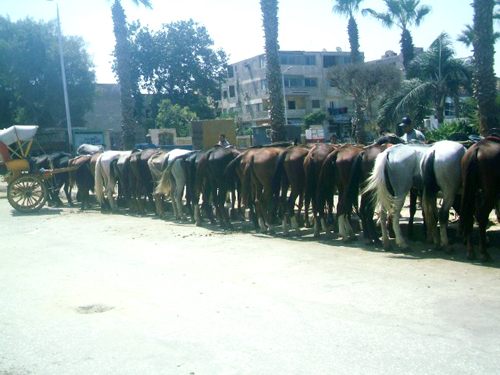
Lunch for horses
From September 1 through September 15, the Pyramids Project fed and treated 2,612 horses and 316 camels.
Since the program was able to start up again this past July, over 4,500 horses and camels have received feeding and vet care.
The animals are growing stronger and are in better shape now thanks to the extra vitamins and minerals they are getting, along with bran added to their food.
Lining up for food
For working horses and camels, who can suffer injuries and extra wear and tear, nosebands, fly masks, and special saddle wound pads called “doughnuts” help them to live lives free of pain. ESAF vets paid special attention to their teeth and hooves. Brochures were handed out to raise awareness of horse and camel care. For the animals who were unwell, medical cards were issued for follow-up vet care and extra feeding.
September 15 marks the end of Phase One of the Project. September 15 through the end of September was financed by funds remaining from the previous project. Phase Two will begin on October 1.
The Pyramids Project is being generously supported by SPANA, Animal Aid Abroad, HSI, Wereld Asielen, Sue Evans and her UK group, who have sponsored the continuation of the project for an extra month.
“India’s animals have strong indigenous allies. The nation is blessed with many dedicated animal welfare organizations.
“Help Animals India seeks out the best of these under funded organizations to provide financial and practical assistance where it can make the most difference.
“We strive not only to achieve immediate benefits for India’s animals, but to nurture an enduring culture of animal protectionism.”
– Help Animals India
Help Animals India gives grants to many very worthwhile, dedicated animal groups in India, enabling them to save and provide care for thousands of animals.
To have a look at Help Animals India’s new website, click here.
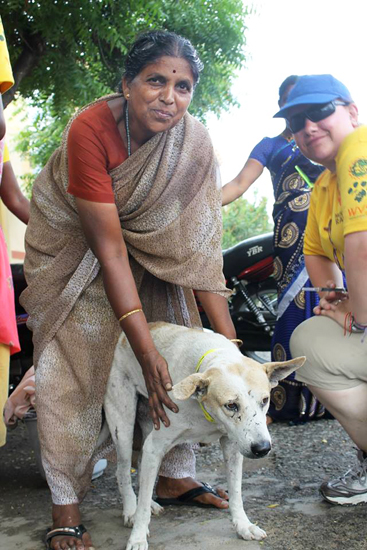
Photo: Courtesy of Help Animals India / Ms. Sharada Buddhiraju, VSPCA, with a rescued puppy
Kindred Spirits Animal Sanctuary Fall Open House!!
ONE DAY ONLY!
Saturday, September 28, from 10am-4pm
Please come to our Fall Open House this coming Saturday, September 28 from 10am-4pm. We have new residents who are excited to meet you as well as three FREE presentations from our Wellness Care Program. As always it will be in the beautiful surroundings of our sanctuary and we will offer healthy snacks and many, many tail wags.
Plan to attend one, or all three presentations in our educational program:
11 a.m.-12 p.m.
◦ Wellness care, with Ulla Pedersen, founder/Director of Kindred Spirits Animal Sanctuary
12:30 p.m.-1:30 p.m.
◦ Canine Massage, with Breck Breckenridge
2:00 p.m.-3:00 p.m.
◦ Senior Dog Rehabilitation, with Sue McKelvey, DVM
Bring a friend and enjoy the crisp air and colorful changes around the barns.
Doodle Bug and Dixie Belle will greet you at the gate!
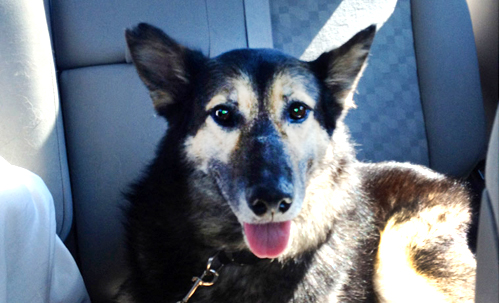
This is a different dog, Chippers, also rescued by Animals Lebanon.
Animals Lebanon in Beirut is helping many Syrian refugees with their animals.
In the September 9, 2013 issue of the Lebanon Daily Star, Brooke Anderson, in her article, “Animals Lebanon marks five years of awareness,” writes about the dedicated work that Animals Lebanon is doing in circumstances made challenging by the nearby war in Syria.
Now around one quarter of the population of Lebanon is made up of refugees who have fled from Syria.
In November 2012, Jason Mier, Executive Director of Animals Lebanon, received an email from a man in Damascus. An accompanying photo showed the man, wearing a hardhat, sitting with his dog, who he’d had for fourteen years. The man, whose name is Maan, wrote that he’d been more or less confined to his small apartment for the past year with his dog, Juicy. The neighborhood was being bombed every day.
He wrote that he was planning to go to Switzerland to live with his daughter, but that he wouldn’t leave without Juicy. Because of the Swiss quarantine regulations, his dog wouldn’t be able to enter Switzerland for two months. He’d prepared nine pages of information and travel documents for Juicy, and he asked that Animals Lebanon please help by finding her a safe place to stay for two months until she could enter Switzerland to be with him.
Of course, Jason Mier immediately replied that they would help, and he found a foster home in Beirut where Juicy stayed for two months, before joining Maan in Switzerland.
Animals Lebanon is receiving about five similar requests each day from Syians for help with their animals, as well as the sixty or so requests they normally respond to.
Jason Mier says there are four small zoos in the Damascus area, and it’s difficult to get information about how the animals are doing.
In areas of Syria where there’s been a lot of shelling or where there are food shortages, life is very hard for the animals. Animals Lebanon is doing everything they can to help the people and their animals.
To read the original article in the Lebanon Daily Star, click here.
To visit the website of Animals Lebanon or to donate, click here.
Photo: Courtesy of Animals Lebanon / This is a different dog, Chippers, who was rescued in Lebanon and now has a happy home in the U.S.











 Art, animals, and the earth