

Along with habitat destruction, hunting and the wildlife trade could put an end to the existence of these great creatures.
Sourced through Scoop.it from: www.treehugger.com
Along with habitat destruction, hunting and the wildlife trade could put an end to the existence of these great creatures.
Sourced through Scoop.it from: www.treehugger.com
<a href=’http://ad.doubleclick.net/jump/Inhabitat/news;article=articlename;kw=content1;sz=300×250;ord=123456789?’ target=’_blank’ > <img src=’http://ad.doubleclick.net/ad/Inhabitat/news;article=articlename;kw=content1;sz=300×250;ord=123456789?’ border=’0′ alt=” /> </a> 
Spokesperson Jeff Ramsay reported, “It is our stern belief that safari hunting of threatened species such as lions has the potential to undermine our regional anti-poaching efforts as it encourages illegal trade which in turn promotes poaching. To this end, individuals partaking in such sport hunting expeditions will not be welcome in Botswana.”
Related: Zambia finally bans the hunting of endangered lions and leopards
Just last week, Zimbabwe officials released a statement calling for Palmer’s extradition back to the southern African nation to answer for his crime. There has been much discussion on how nations which are home to these hunted species are cracking down on what is called “canned hunting,” or exporting wild animals to other countries to be hunted down for sport, and Botswana is proud to stand against such activities. Let’s count…
View original post 42 more words
<a href=’http://ad.doubleclick.net/jump/Inhabitat/news;article=articlename;kw=content1;sz=300×250;ord=123456789?’ target=’_blank’ > <img src=’http://ad.doubleclick.net/ad/Inhabitat/news;article=articlename;kw=content1;sz=300×250;ord=123456789?’ border=’0′ alt=” /> </a>
Spokesperson Jeff Ramsay reported, “It is our stern belief that safari hunting of threatened species such as lions has the potential to undermine our regional anti-poaching efforts as it encourages illegal trade which in turn promotes poaching. To this end, individuals partaking in such sport hunting expeditions will not be welcome in Botswana.”
Related: Zambia finally bans the hunting of endangered lions and leopards
Just last week, Zimbabwe officials released a statement calling for Palmer’s extradition back to the southern African nation to answer for his crime. There has been much discussion on how nations which are home to these hunted species are cracking down on what is called “canned hunting,” or exporting wild animals to other countries to be hunted down for sport, and Botswana is proud to stand against such activities. Let’s count…
View original post 42 more words
 Mrs. Usha Sundaram and Captain Sundaram
By Sharon St Joan
This is one of a series of stories about the early days of the animal welfare movement in India.
To read part one first, click here.
Later that same year, in 1963, the CPCSEA was formed — thanks to the initiative of the well-known Indian classical dancer and animal activist, Rukmini Devi. The CPCSEA (Committee for the Purpose of Control and Supervision of Experiments on Animals) oversees the facilities that perform animal experiments. Dr. Krishna, his mother, and his father, met twice with the CPCSEA committee members to give an account of the experiments at the Kilpauk Medical Center. At first they weren’t taken seriously. Some people even laughed, and there was some disbelief that such things as grafting of dogs’ heads had actually happened. But later on, the committee members were able to see for themselves what…
View original post 837 more words
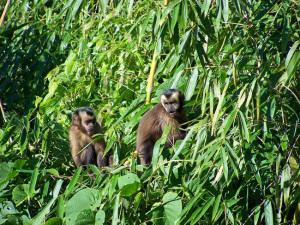 Brown Capuchin Monkeys, Peru
Whether we observe monkeys in the wild or at the zoo, they often bring a smile to our faces, as we watch their antics and activities. The New World monkey called capuchins, from the Genus Cebus, are widespread.
There are many kinds of capuchin monkeys, so named for their resemblance to the brown-roped attire worn my capuchin monks. The brown capuchin or Cebus apella, photographed here, can easily be found in the Amazon rainforest.
They are usually seen dancing in the treetops searching for food. Their diet is wide and varied, ranging from frogs to fruits and everything in between. They look like they are flying, as they grab onto one branch and skillfully glide through the air to the next branch, cavorting with their mates.
I’ve heard it said that humans find monkeys endearing because they have a resemblance to our species. Although…
View original post 26 more words
This 10 May 2015 video is called Birds and Animals at Vwasa Lodge, Malawi.
From Wildlife Extra:
African Parks takes over Liwonde NP and Nkhotakota Wildlife Reserve in Malawi
African Parks, the non-profit organisation that takes responsibility for the rehabilitation and long-term management of national parks and protected areas in partnership with governments and local communities, has concluded an agreement with the government of Malawi to manage and operate Liwonde National Park and Nkhotakota Wildlife Reserve for 20 years.
The agreement follows an application and evaluation process administered by the Public Private Partnership Commission in which African Parks emerged as the preferred partner to manage the two protected areas.
Liwonde National Park, located in the southern Malawi is 548[k]m² in size and consists of woodland, floodplains, grasslands, and lagoon. It supports the largest remaining population of elephants in the country as well as one of two populations of
View original post 385 more words
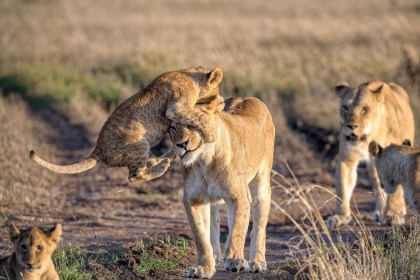 Lion cub and lioness in Naboisho Conservancy, Masai Mara, Kenya by Marja Schwartz
I love this photograph, and many others entered in the National Geographic Traveler Photo Contest. Some of the other entries follow below and see here for a wide selection. With so many people with cameras and the plethora of images in our daily lives with social media and Instagram etc, it is great there are now so many competitions giving photographers greater exposure. Countless images of our beautiful natural world and wildlife can only contribute to renewing our efforts for urgent protection.

BORN FREE: After the initial successful fund raiser for Animal Works and The Feline Foundation, I have been asked again to introduce the classic film Born Free on Saturday 8th August at 2pm, at Event Cinemas, George Street, Sydney. I loved seeing the film again. The story of Elsa the lioness is…
View original post 1,893 more words

 Our friends over at Living With Wolves in partnership with National Geographic have put together a Gray Wolf Educator Guide for use in Schools.
Why teach about wolves?
The purpose of this guide is to provide educators of students from kindergarten to high school with activities that will enrich students’ understanding about the gray wolf of North America. The activities are intended to dispel common myths and prejudices that are held about these animals and to encourage youth to get involved in conservation efforts.
Wolves are more like humans than many realize. Students will find that they can relate to this animal because the lives and experiences of wolves mimic those of humans in many and often surprising ways—from their social structure and family roles to the experiences of bullying and being misunderstood. Because of the myths and prejudices held by many and a history of persecution that continues today…
View original post 88 more words


 Art, animals, and the earth