These are a few of the remaining pieces of Laura Merrill’s beautiful stained glass artwork:
Glass boxTotem Mandala – CardinalsBighorn Sheep
For pricing and to read about Laura’s book Secret Voices from the Forest, as well as many other articles about trees, visit her website, the Treetalker.
Animals Asia (www.animalsasia.org) has welcomed news that China intends to end laws requiring cosmetics to be tested on animals.
Guidelines from the China Food and Drug Administration suggest animals testing will no longer be mandatory from June 2014. This will initially be applied to China-made products and eventually, it is anticipated, to imports.
Animals Asia Animal Welfare Director Dave Neale said:
“This is not the first time in recent weeks that we have talked of significant breakthroughs in terms of animal welfare in China. Young people are turning in greater numbers to animal welfare activism and they are being heard.
“This change has been long hoped for but few anticipated it happening quite so soon. In many ways this is a victory for all anti-testing campaigners. The people who persuaded Western governments to ban animal testing have caused a domino effect that has resonated with both the authorities and people of China resulting in this ground-breaking progress.
“The world has long talked of China being open for business – well now it’s open to discussion too. China is listening and it’s taking action.”
Past regulations meant that if international cosmetics companies wanted to market ranges in China they were forced to test on animals – a fact unlikely to go down well with customers elsewhere.
It’s hoped that while testing on animals has not been outlawed, the option now to create “cruelty free” brands will see increasingly aware consumers lured away from brands associated with animal testing.
Animals Asia founder Jill Robinson added:
“A changing China is the biggest story in international animal welfare activism today. Just as regulations for testing cosmetics can become internationally standardised – so can concepts of animal welfare and conservation.
“Environmentally speaking China is more self-aware than it has ever been. Young people, journalists, politicians, businessmen, China’s citizens – they are all pushing hard for change and there is much evidence to suggest they’re making headway.”
The power has been down here since the area was hit by cyclone Phailin and the floods that followed; this has meant that we’ve had no way to communicate.
Most recently, we rescued more than 1,000 animals from severe flooding in the Aska block of Ganjam District, where three villages were cut off for two days by floodwaters. They were in great danger, but thank God, we were able to save them.
(The Ganjam District of Orissa is on the border of Andhra Pradesh.)
Thanks to all our volunteers and supporters, and with the help of local farmers, we were able to give the animals shelter, a safe place for them to rest, and food.
We’ve continued our work of repairing shelters, and we’ve been educating the owners in the care and adequate feeding of their animals, sometimes returning to the same sites three and four times, as needed. Having repaired more than 1200 shelters so far, we’re happy to see the animals now resting in a dry place, with proper food to eat.
We wish we could cover the entire flooded area of Odisha, but we do as much as we possibly can, as much as time and our finances will allow. We are pleased that we’ve been able to help so many animals.
To visit the website of the Maitri Club, click here.
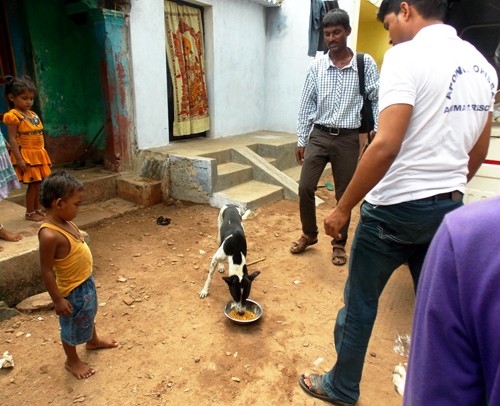
Many neighborhood dogs are hungry and scared; our rescue team is feeding these animals with the help of village volunteers.
By Rashmi Ranjan
On behalf of the APOWA Team
Our disaster response team is still hard at work conducting emergency rescue and relief efforts for the animals and people affected by cyclone Phailin and the flooding. The havoc didn’t end with the flooding, but another disaster in the form of incessant heavy rain due to low pressure across the Odisha coast since October 22, 2013 has brought flash floods to severely affected coastal districts. This has also hampered recovery and rescue efforts.
We are providing emergency food, water, medical treatment and, just as important, compassionate care to cyclone victim dogs, cats, goats, sheep, donkeys, and cattle. We are working in the worst affected areas of the Ganjam and Kendrapara districts of Odisha state.
October 24, 2013
We traveled to Kalyanipur village in the Kainchapur panchayat of the Ganjam district, one of the areas hardest hit by cyclone Phailin. Over a hundred homes were leveled. The scene, even more than one week after the cyclone, is truly catastrophic.
At Kalyanipur village, Bichi, Mantu, Sukumar and Bijaya pitched in to help with feeding stray dogs, cats and bulls. The animals were very happy to eat. They fed 86 animals in this village. Subhajyoti, Magta, Nimain, and Fakira assisted Dr. Behera and Dr. Piyush, who is a vet with HSI – Asia (Humane Society International), in treating affected animals. By the end of the day, they had treated 91 animals.
Mr. Mantu, one of our disaster response team members, rescuing an injured calf to be treated.
October 25, 2013
The APOWA disaster rescue team is continuing to bring food and treatment to affected animals. Our team, which includes two veterinarians and several volunteers, has been working continuously in the affected areas, supporting relief efforts and providing treatment and emergency feeding. Today, we visited Sanakainchapur of Kainchapur panchayat in the Ganjam district. 76 animals were given food and medical care in this village.
October 26, 2013
Today, our team visited Jagannathpur village of Kainchapur panchayat of the Ganjam district to respond to an urgent plea for help. Our rescue team worked long and hard, and were able to provide relief to 133 animals. They were also given a vitamin supplement. The team immediately got to work mixing vitamins and nutritional supplements into the food for the cattle. The team were helped by community volunteers from the village. This was truly an amazing community of animal lovers!
A cyclone survivor from Satrusoul village, who is a community volunteer, brings his companion dog for treatment.Mr. Bijaya is helping a puppy, while our team feeds her mother.
October 27, 2013
Our disaster response team has been working for the last two weeks to provide relief and rescue to the surviving animals. Today, we visited Borigaon village in the Humma panchayat of the Ganjam district. There we worked with our dear friend, Mr. Rabindra Sahu, and volunteers from the Rushikullay Sea Turtle Protection Committee, Ganjam. Our team treated 92 animals for various ailments, like fevers, coughs, and injuries caused by the cyclone and floods.
We are also bringing food for stray bulls in flooded areas.
October 28, 2013
It was another long working day for APOWA’S disaster rescue team in Satrusoul village in the Subalaya panchayat of the Ganjam district. Our team reached 208 cyclone victim animals providing food and medical treatment. This was a tiring day especially for the drivers Subhajyoti and Mantu who had to drive ten hours straight. The drivers’ dedication to APOWA’s mission and to the animals cannot go unmentioned. Nonstop work, loading, walking, and handling animals illustrate what teamwork and love for animals really means.
One of our volunteers is traveling with medicines to a flooded village to provide relief to the animals.
This disaster makes everything worse for animals that are already hungry and scared; they search for food. It is estimated that thousands of animals, mostly dogs, cats, and cattle were impacted by the cyclone and flood. Many were injured, sick, weak, and suffering from malnutrition. The unspeakable misery of animals cannot be described in words. APOWA has a long history of responding to natural disasters, which happen in Odisha regularly. “We were one of the few animal welfare organizations on the ground in the aftermath of Cyclone Phailin,” says Dr. Laxman Behera, veterinarian, who is leading our disaster response team. “Not only have we been rescuing hundreds of animals, but we gave them the food and medical care they needed.”
Amazing Volunteers:
We are grateful to over 20 volunteers who devote their time and love to help us in our mission to rescue, nurture and provide emergency feeding to cyclone and flood victim animals in Odisha. Mr. Bichitra Biswal, who traveled from the Puri district, is part of a dedicated group of core volunteers who have been helping us since the beginning of the cyclone. We are also mobilizing village volunteers who come forward to help in our relief efforts for animals in their village. They are a terrific group of volunteers and we thank them for all of their hard work and support! It is a great feeling to know that we are making a difference for animals. It has always been and will continue to be all about the animals.
In this precarious situation we would request to all to extend your kind support to continue our life- saving work in areas hit hard by the cyclone and floods.
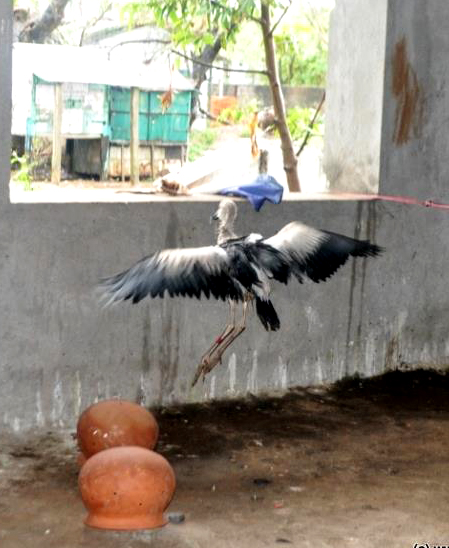
Cyclone Phailin took a profound toll on the colony of Asian open billed storks living in a coastal wetlands on the Bay of Bengal, in Andhra Pradesh. The VSPCA (Visakha Society for Prevention and Care of Animals) has protected and cared for these wild storks for a number of years, working with village people to protect their habitat and prevent poaching.
The storks migrate to Telekunchi in Icchapuram, at the northern tip of Andhra Pradesh, in the Srikakulam District.
Pradeep Nath, Founder and CEO of VSPCA, writes that the birds “have met with a disastrous situation due to the super cyclone ‘Phailin’ that ripped through north Andhra Pradesh and Orissa in the early hours of October 12.
“Some 4,000 storks perished that night. Another 2,000 were left grounded with trauma, fright, separated from their families and abandoned, terribly wet and unable to move and feed by themselves.”
Quite a number were injured and “around 33 were just chicks who required hand feeding.”
The day after the cyclone hit, a VSPCA team was out combing the beach looking for injured animals, moving north from the town of Srikakulam towards Palasa, when they began to get calls about the storks in distress.
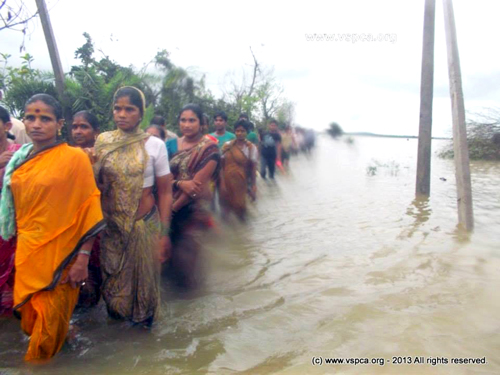
Women from the village near where the storks live.
They immediately left the beach and traveled to Icchapuram to aid the birds.
Arriving on the site, the VSPCA team began rescuing hundreds of birds, providing emergency treatment and medical care.
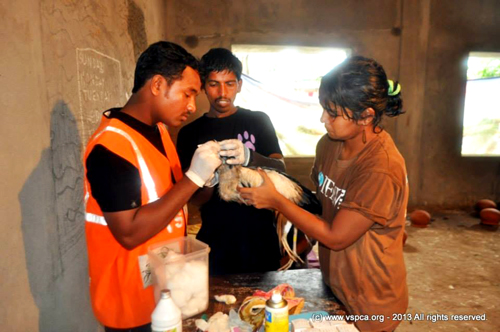
For weeks, they worked to save the lives of the birds, setting up a hospital in a darkened school building, with open doors and windows, in conditions that could not be kept sanitary. Outside there were fallen trees and electric poles. The power was always out.”
In these far from ideal conditions, the VSPCA team did a heroic job, despite not having much in the way of good food, or a proper place to stay, or a chance to catch up on sleep.
Pradeep Nath explains “We focused on keeping the birds warm, cleaning them, providing vitamins, and supportive care. Soon, around 1,650 birds were strong enough to fly up into the trees.
“Seeing them active and able to fly gave us a huge sense of relief.”
Progress made despite difficulties
Over the next few days, there was quite a lot of flooding, but they were still able to make progress in getting the remaining birds back on their feet.
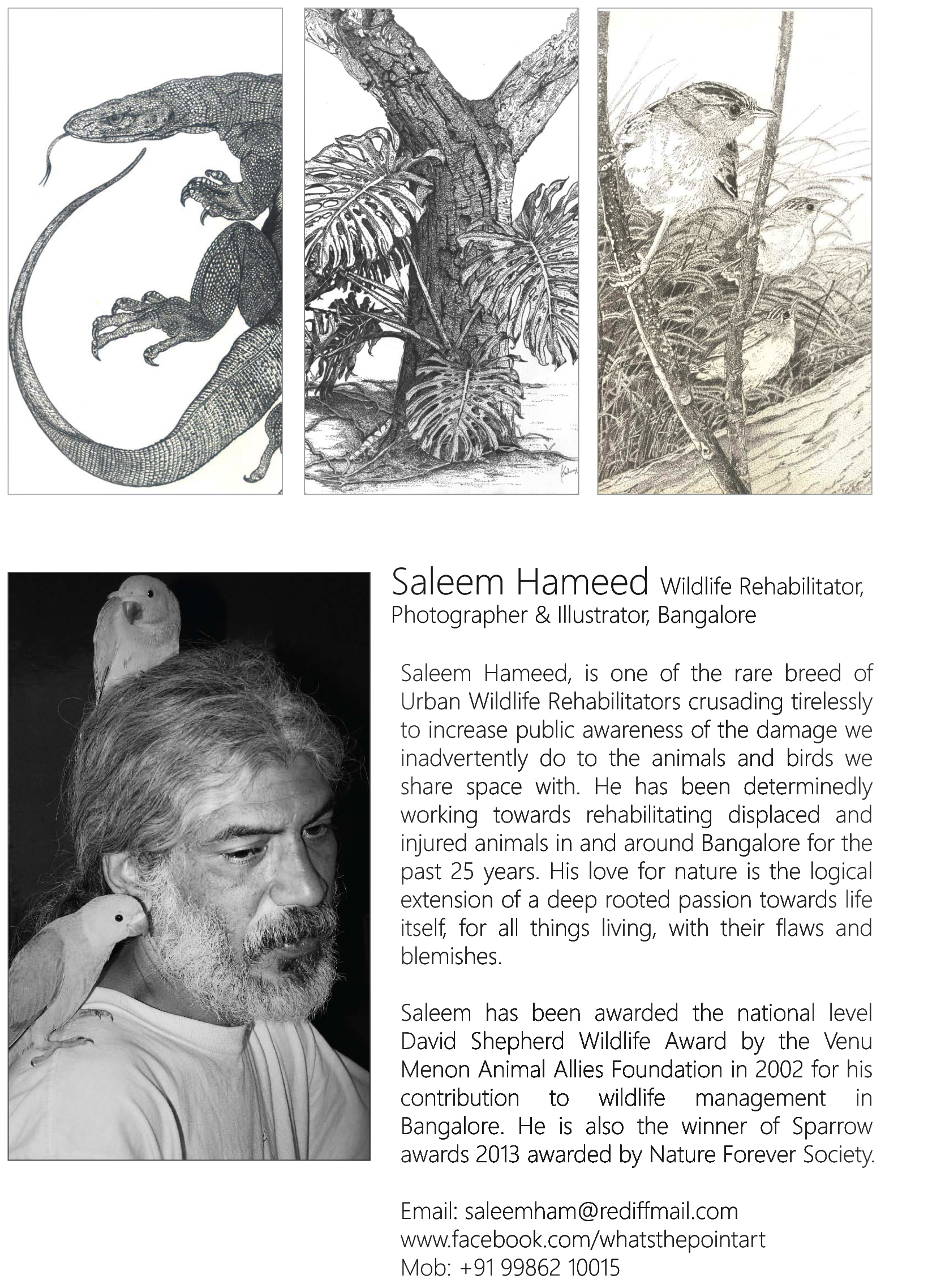
“Some of the birds were injured, and there were very critical cases too, requiring special treatments. Following our appeal, teams from Wildlife Trust of India, Wildlife SOS, and PFA – Bangalore came to help out. Saleem Hameed, an experienced wildlife rehabilitator, sent by PFA – Bangalore, stayed and worked with us for an entire week.
Cleaning and drying the drenched birds.
“The WTI sent a second vet a few days later, after we again appealed for help because of renewed flooding, including in the wetlands where the bird colony lives.
“The 350 birds that had remained in the school for special attention were treated, and later on, having recovered well, many were released.
“Quite a few walked out of the building, which did not have doors and windows, on their own, as soon as they felt better.
“Sadly, some had died from infections or from severe injuries.
“After a week, we had less than 46 still in our care and under close watch.”
Treating a sick bird.
Heavy rains bring a turn for the worse
Unfortunately, all did not continue to go well, and on October 19, there was a disastrous turn in the weather.Heavy, pounding rains came in from the coast. The rain did not stop falling and inundated the entire state, especially the coastal areas.
The weather was so bad that roads became impassable, and the team, who were staying nearby in Icchapuram, had trouble reaching the birds to give them food and medicine.
On top of that, because birds, when subjected to extreme stress and bad weather, lose their water proofing, which causes them to become cold and ill — many of the storks could not withstand the heavy rains. Many had to be recaptured, dried, and warmed up. Keeping them warm and finding adequate supplies of food for them was a struggle.
The skies clear
Eventually, the rains dissipated. Fortunately, in the end, they were left with only one bird that could not be released. This bird will either be placed with the Forest Department or will have a home at the VSPCA Kindness Farm.
Sadly, some of the recaptured storks died. All the others have been rereleased, are gaining strength day by day, and bit by bit are making their way up into the trees.
The VSPCA team has stayed with the birds throughout all the flooding and the many challenges, doing everything possible to care for them, and they continue to provide food for those still on the ground.
Pradeep Nath writes, “Our team will continue to stay until 100% of the work for the safety of the birds has been done. We have identified one elderly person who will represent us and inform us of any problems. Our team will continue to help the birds on the ground until they fly up to the trees and then onwards. And our team will encourage local authorities to inform people using vehicles to go slowly in these areas because there are many birds still on the ground.
“At the moment, our work for the Asian open billed stork is almost done. We will be there only another week or ten days.
“It is so heartening to see them flying higher and higher in the skies.”
Thanks to VSPCA for their steadfast help for these magnificent birds caught in such a perilous situation.
If you’d like to help with a donation, via Help Animals India, click here.
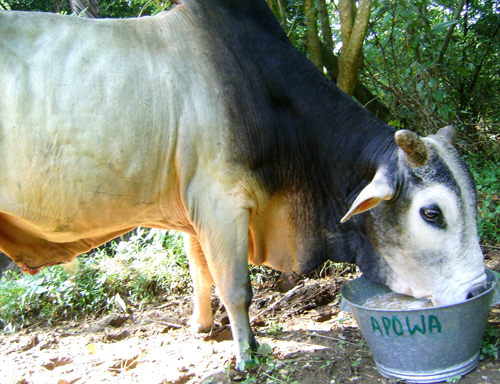
A stray bull being fed by Mr. Mantu Das, a volunteer with our disaster response team.
By Rashmi Ranjan,
On behalf of the APOWA team
APOWA has been providing relief to animals in cyclone- and flood-affected villages of Odisha, India. Phailin left a trail of destruction. According to the report of the Animal Resource Development Department, Government of Odisha, over seven million animals were adversely affected.
The cyclone, attaining a windspeed of 220 kilometers per hour (136 miles per hour) killed 1,500 large animals, 3,000 small animals and 600,000 birds.
Recent heavy rains, due to another low pressure system that formed over the Bay of Bengal on the Odisha coast, have worsened the suffering of Phailin victims. A continuous downpour has made life precarious and painful in the affected areas.
Since the cyclone struck, APOWA’s disaster response team has been conducting rescue and relief work on the basis of a war footing. We’ve been helped by five animal caretakers who feed neighborhood dogs and an honorary animal welfare officer, certified by the Animal Welfare Board of India.
Our Kindness vehicle has been traveling from village to village in the affected areas, offering much-needed assistance and providing vital resources to the animals in distress. Our team of one veterinarian, three paravets (vet techs), and 14 volunteers has been on the go tirelessly, treating animals and providing emergency feeding.
Mr. Bijaya, of APOWA, with neighborhood dogs in Singhagaon village.
October 19, 2013
Our team spent a whole day at Singhagaon village, where a great many animals – neighborhood dogs, stray bulls, cats, and buffaloes were suffering from injury, hunger, dehydration, fever, and coughs. Some kind volunteers from the community joined our team and pitched in, helping to feed the dogs, cats, and cows. Our team provided treatment and feeding to 68 animals in the village.
Mr. Mantu Das feeding hungry cows in affected areas.
October 20, 2013
It’s been a full week since we started providing relief to the surviving animals of the cyclone and flooding. Today, we rushed to Bishnupur village, where we treated and gave food to 54 animals.
October 21, 2013
Today our team treated and fed 71 animals at Berhampur village of Pattamundai block.
October 22, 2013
A team from Humane Society International (HSI) Asia headed by Soham Mukherjee and two veterinarians joined our team at Kantiagarh and Laxmipur village of Ganjam District. There 133 animals were treated and emergency feeding provided.
Two volunteers brought two baby goats to Dr. Laxman Behera for treatment.
October 23, 2013
We continue our lifesaving work for animals and our rescue and relief efforts. Our team moved to Kusumi village of Aul block, which had been cut off, entirely surrounded by rivers and severely affected by both the cyclone and the floods. There 83 animals were treated and 52 animals were given food.
Our disaster response team traveled by boat to reach cyclone and flood victims.
Our priority in this disaster is to aid homeless, stray animals who need emergency vet care and food. At the same time, we are continuing our regular work helping other animals.
Without proper electricity and no drinking water, food procurement is a big problem faced by our team. Despite the difficulty, we’re doing everything possible to get food and treatment to the animals. Because of our love for the animals, we will continue to stay here, working on their behalf until the situation improves.
We are grateful to all of our supporters, well-wishers, and to the district administration for their timely cooperation in our work for the animals in the aftermath of cyclone Phailin.
Faizan Jaleel, animal advocate and Muslim, gives a compassionate and clarifying insight into the original intent and meaning of Eid – Editor
Many million goats, cows, bulls, camels, sheep and buffaloes have already been slaughtered (sacrificed) in the way of Allah (the most merciful, beneficent and loving) – when we refer to Allah as a Muslim with faith on the holy Quran, it goes out without effort that we are referring to ALLAH – the most merciful, beneficent and loving and this does not limit only to Humans but to all the life and life forms in the entire Universe. When I see it in the reflection of blood and pain that poor animals are subjected to during the festival, I feel pained at the very abject misunderstanding of Islam and Allah’s wishes by my fellow brothers and sisters.
It is indeed very difficult for a Muslim to unlearn and relearn especially in terms of religion or may be this holds true for every religion as presented by humans in their current form. “How can we give up Qurbani (ritual sacrifice of an animal), what will people say” or “I have the best and the most expensive Bakra (Goat)” or “I sacrificed three goats and a bull” – this certainly is not what Allah wanted to convey through the pinnacle of sacrifice that Prophet Ibrahim undertook and selflessly performed. He was pained at the thought of sacrificing his son, with tears in his eyes and since he was not able to see what he was supposed to do, he blindfolded himself – that was the pain of sacrifice and there was this lesson – that Allah may want you to sacrifice whatever and however dear it may be to you! And today what have we made of this lesson is for ourselves to introspect and decide. You may not be able to or may find it very difficult to hold up against the communities satirical comments and remarks but in your heart you will understand and know that this is not what is required, may be letting go of a goat (letting her live) that you just bought out of your savings is a better sacrifice than slaughtering that poor animal to prove that you are an abiding muslim and live your life in accordance with what you have seen and experienced (not studied and understood)!!
Indeed Allah the merciful, beneficent and loving has created everything in this universe and mankind is supposedly the best of all the creations and yes indeed Allah has allowed to us the meat of certain animals and all the good things like fruits and vegetables but in giving us all this, Allah has given us a choice of selection – and the choice is ours to make!
There is nowhere in the holy Quran mentioned that you will not be considered a Muslim if you do not consume meat or you will not be a good muslim if you only consume veggies and fruits. So the choices we make are all ours and putting these choices on Allah’s will is sheer ignorance and lack of will to stand up to what is right.
To make my point more simple, Islam has defined what is called as the “Five Pillars of Islam” – to be considered as five primary obligations that each Muslim must fulfil in his/her life time and these are:
Shahadah:The complete acceptance of faith that “there is no God but God and Muhammad is the messenger of God” – one statement or as we call it the “Kalma” that expresses a complete acceptance of Islam and commitment towards it.
Salah: The prayers, (five times a day) second pillar of Islam, Islamic faith is based on the belief that individuals have a direct relationship with Allah
Zakat: Almsgiving is the third pillar of Islam, it is an obligation for each Muslim to give Zakat, a certain percentage of the net worth (2.5%) has to be given on a regular basis
Sawm: Fasting during the month of Ramadan is the fourth pillar of Islam
Hajj: The pilgrimage to Makkah is the fifth pillar of Islam and a duty for all the Muslims in the world who are physically and financially capable of taking up the journey.
These five pillars provide the basic identity to a Muslim and as we can see, it no where includes eating meat, or slaughtering animals for business and food as a mark of a Muslim.
I can say from my own exposure and experience to a multitude of muslim communities across India that a majority of Muslims find it quite difficult to follow these basic pillars of Islam. But a majority of the same Muslims will sacrifice a goat or any other allowed animal to reiterate the misleading fact of being a Muslim or being a part or larger Ignorance of Muslims.
I get many messages with abuses, hurts and full of indecency for my efforts to portray the very polite, humane and natural side of Islam and I know with conviction that my Allah wants me to do this. However I best ignore them as they are work of misguided minds and lack of enlightenment. They have read the scriptures but haven’t yet understood the meaning – the same way as this year on Eid al Adha, they have slaughtered many animals, millions of them without making any sacrifice!!!
I have firm faith that things will change and cruelty will end – someday soon we will have our EID – of peace, love and compassion!
Do visit and like my page on facebook: “Celebrate Eid al Adha without Cruelty”
This year we did engage with some, Inshallah till next Eid we will have more enlightened minds to spread the message of peace and love for all life forms!
To visit the Facebook page “Celebrate Eid al Adha without Cruelty,” click here.
APOWA’s disaster rescue team member, Mr. Subhajyoti Panda, feeds a homeless dog in Pallibandha village of Ganjam district.
By Rashmi Ranjan,
On behalf of the APOWA Team,
Odisha, India
APOWA’s Disaster Response team is working to help the animal survivors of the devastating cyclone and flood in Odisha. Our team has been working relentlessly since the cyclone ‘Phailin’ hit the Odisha coast on October 12, 2013. The footprint of the cyclone is huge and immeasurable.
October 16, 2013:
One of our teams, headed by Dr. Laxman Behera, reached Pallibandha in the Ganjam block of Ganjam district, a village with a mostly homeless dog and feral cat population, already struggling to survive before the cyclone. We helped 64 distressed animals by providing food, water, and treatment.
APOWA is a non-profit organisation that mobilizes volunteers and resources for animal victims.
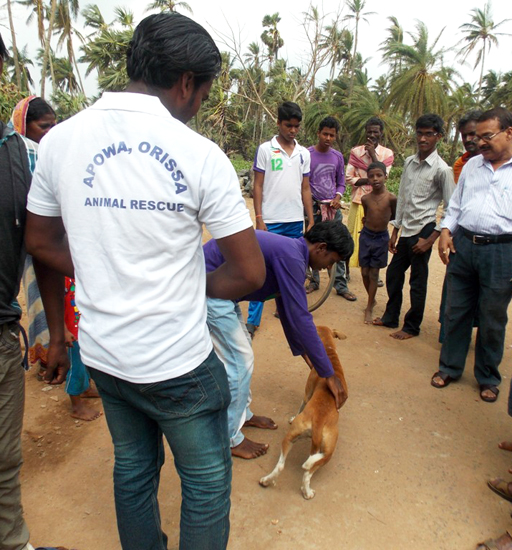
A volunteer helps an injured stray dog, about to be treated by APOWA’s vet doctor, Dr. Laxman Behera, at Pallibandha village in Ganjam district.
Injury and disease are always common following a severe cyclone, whenever saltwater pours into a seaside village.
October 17, 2013:
Our team rushed to Purunabandha, a seaside village in Ganjam district, severely affected by the cyclone. Mr. Bichitra Biswal and Mr. Sukumar Parida, along with two other volunteers, gave emergency feeding to stray dogs, cats, and cattle. Meanwhile, Mr. Subhajyoti Panda and Mr. Rabindra Sahoo assisted Dr. Behera with the treatment of animals. 59 animals were treated by the team in this village.
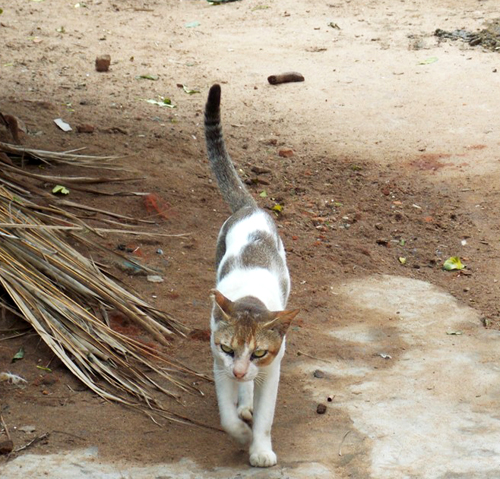
Mr. Sukumar Parida, one of APOWA’s disaster response team members, caring for a surviving cat at Purunabandha village in Ganjam district.We bring food to many cattle roaming in cyclone-affected areas.A surviving feral cat walks along a street in Purunabandha village.
October 18, 2013:
It was another long working day for our team at Binchanapalli in the Palibandha Panchayat of the Ganjam block of Ganjam district. Our work is saving lives through emergency feeding and treatment efforts; we’re giving the most vulnerable animals a chance to get back on their feet in this emergency situation. Over 83 animals have been treated for fevers, coughs, and injuries.
These rescued dogs are so happy to eat, they have no problem sharing their food.Cows are roaming the streets in cyclone-stricken parts of Ganjam district. One of our volunteers is providing emergency feeding.After the cyclone moved along the Odisha coast on October 12, 2013, it left both people and animals feeling insecure and unsettled.
“Animals are the most innocent and helpless victims of this catastrophe,” said APOWA’s vet doctor, Dr. Laxman Behera. “They are frightened, injured and hungry. We are providing veterinary care, as well as emergency feeding and planning for vaccinations and measures to prevent a disease outbreak.”
Because of our past disaster response experience, we now have in place dedication and commitment to hard work, and an understanding of what is needed to deal with the situation. Combined with our genuine love for the animals, our teams will be in place until the situation improves. There is still flooding and anguish in most villages. People’s frustration is running high in affected areas.
For more information or to help APOWA’s flood relief work with a donation, visit the website of Help Animals India.













 Art, animals, and the earth