Saving a sun bear cub in Vietnam

An adorable video…

petrel41's avatarDear Kitty. Some blog

This video from Vietnam says about itself:

1 July 2014

Rescued from poachers, gorgeous sun bear cub Layla arrived at Animals Asia’s Vietnam Bear Rescue Centre in June 2014.

From Wildlife Extra:

A sun bear saved from the illegal wildlife trade enjoys special care in a Vietnamese rescue centre

Layla, the sun bear cub rescued from the illegal wildlife trade, enjoys her paddling pool

Animals Asia’s Vietnam Bear Rescue Centre has just welcomed its newest resident, a five-month-old sun bear cub.

Nicknamed Layla, the tiny 13kg cub is settling into a 45-day quarantine period in a private den in the specially designed cub house.

With a mini paddling pool, fire-hose hammock and low wooden platforms, Layla can explore and play with her coconut, bamboo and rope toys in complete safety.

Layla came to the centre from the Hanoi Wildlife Rescue Centre (HWRC) based in the outskirts of Hanoi.

This…

View original post 263 more words

Invasive Palm Threatens Java Rhino To Extinction

GarryRogers's avatarGarryRogers Nature Conservation

The last of Indonesia’s critically endangered Javan rhinoceroses have survived poachers, rapid deforestation and life in the shadow of one of the archipelago’s most active volcanoes. But an invasive plant is now posing a new threat to the world’s rarest species of rhino.

“Once the most common of the Asian rhinoceroses, the Javan rhino (Rhinoceros sondaicus) started its decline at least 3,000 years ago with the growth of human populations and increased hunting pressures. With its horn fetching $30,000 on the black market, poaching is considered the driver of much of its decline in modern times.

“As few as 58 Javan rhinos exist in the world today, and the species is quite possibly the rarest large mammal on earth. All are found in one small population in Ujung Kulon — a sprawling 1,200-square-kilometer (463-square-mile) national park on the westernmost tip of West Java and the island of Panaitan…

View original post 173 more words

Just One Road Can Destroy a Forest

GarryRogers's avatarGarryRogers Nature Conservation

Roadfree.org

“The international community is engaged in a race to halt biodiversity loss and reduce carbon emissions caused by deforestation. Funding for environmental protection is currently scarce; yet keeping wild areas free of roads is a remarkably cost-efficient way of protecting biodiversity and keeping the planet cool, and is an antidote to slow political decision making. RoadFree brings together environmental experts and partners who are working to keep wild places roadfree.”

Watch the Video.

More posts about roads:

View original post

2013: The Year for Non-Human Rights—Maybe for Chimps

spencelo's avatarAnimal Blawg

chimpanzee

Spencer Lo

Near the end of 2012, Popular Science published an article predicting the top 15 science and technology news stories of this year, with many interesting items such as: “Black Hole Chows Down,” “Supercomputer Crunches Climate,” and “New Comet Blazes by Earth.” One prediction in particular, however, may come as a surprise to readers, and will undoubtedly be welcome news and an inspiration to animal advocates everywhere. I am referring to the seventh “news byte” on the list, which reads:

Animals Sue For Rights

Certain animals—such as dolphins, chimpanzees, elephants, and parrots—show capabilities thought uniquely human, including language-like communication, complex problem solving, and seeming self-awareness. By the end of 2013, the Nonhuman Rights Project plans to file suits on the behalf of select animals to procure freedoms (like protection from captivity) previously granted only to humans. 

The end of 2013 is getting closer (more than halfway there), and as…

View original post 580 more words

Brünnich’s guillemot video, Svalbard

Sentience in Plants: Plants Respond to Sound of Chewing Caterpillars

GarryRogers's avatarGarryRogers Nature Conservation

Plants Hear and Respond

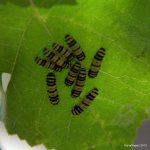
12-IMG_3490 Caterpillars on a Grape Leaf

“Previous studies have suggested that plant growth can be influenced by sound and that plants respond to wind and touch. Now, researchers at the University of Missouri, in a collaboration that brings together audio and chemical analysis, have determined that plants respond to the sounds that caterpillars make when eating plants and that the plants respond with more defenses.

“Previous research has investigated how plants respond to acoustic energy, including music,” said Heidi Appel, senior research scientist in the Division of Plant Sciences in the College of Agriculture, Food and Natural Resources and the Bond Life Sciences Center at MU. “However, our work is the first example of how plants respond to an ecologically relevant vibration. We found that feeding vibrations signal changes in the plant cells’ metabolism, creating more defensive chemicals that can repel attacks from caterpillars.”Appel collaborated with Rex…

View original post 285 more words

Why Animal Rights?

GarryRogers's avatarGarryRogers Nature Conservation

Almost all of us grew up eating meat, wearing leather, and going to circuses and zoos. Many of us bought our beloved “pets” at pet shops, had guinea pigs, and kept beautiful birds in cages. We wore wool and silk, ate McDonald’s burgers, and fished. We never considered the impact of these actions on the animals involved. For whatever reason, you are now asking the question: Why should animals have rights?

“In his book Animal Liberation, Peter Singer states that the basic principle of equality does not require equal or identical treatment; it requires equal consideration. This is an important distinction when talking about animal rights. People often ask if animals should have rights, and quite simply, the answer is “Yes!” Animals surely deserve to live their lives free from suffering and exploitation.

“Jeremy Bentham, the founder of the reforming utilitarian school of moral philosophy, stated that…

View original post 134 more words

Gallery: Carlsbad Caverns in New Mexico, U.S.

Gallery: Carlsbad Caverns in New Mexico, U.S.

International Bellhop's avatarInternational Bellhop Travel Magazine

Carlsbad Caverns Guided Tour

250 million years ago, the Guadalupe Mountains — in what is today known as New Mexico, U.S. — were the ancient shoreline of a vast inland Sea that covered a great area of plains states. Today, much of New Mexico is covered with parched desert lands, though there are many features in this land that are still remnants of that long lost sea. The Carlsbad Caverns are one of the most impressive features created by the retreating waters from long ago. The caverns are an immense series of single caves, or “rooms,” which follow the path of the original water’s retreat through the hard limestone and soft clay and dirt. Not only is this one of the largest cave systems that has been discovered in America, the details of this system of caves is what sets it apart from any other.

179321969

Carlsbad Caverns Entrance

This winding switchback into the mouth…

View original post 358 more words

Common Grass Yellow Butterfly

Salim.E.I's avatarOrganikos

Photo credit : Sherif Photo credit: Sherif

The Common Grass Yellow Butterfly lives up to its name. Found throughout all of India, this lepidopteran flies low and close to the ground in fields, and its wings are a pretty yellow with some subtle patterning. Their larvae feed on several different plants, but generally in the families of the spurges and legumes. 

View original post 40 more words