(You may notice a revision in this story – please see the note below.)
Adonis, when he first arrived, had been saved from a miserable life. Barbara Lefranc, President of the Le Bulletin Des Levriers (Bulletin of Sight Hounds) expresses the words Adonis would speak if he could, “Yes, it’s me, the companion you are waiting for. I’m doing well now. I’m going to gain weight and become handsome again. I’ll forget my past and eagerly devote myself to my favorite interest in life, making sure that you love me.”
Adonis (on the right) at home
Adonis was adopted in February and has gone to his new home where he will always be loved. Le Bulletin Des Levriers rescues dogs, especially greyhounds and other sight hounds, that are used in Spain for hunting. In partnership with Spanish rescue groups, they are saved from abusive situations, and are then brought to France where they are placed in loving, forever homes.
To visit the website (in French) of Le Bulletins Des Levriers, click here.
Adonis with Dad
Photos: Courtesy of Le Bulletin Des Levriers
Note: This story and the photos are correct, but in the first version I had mistakenly used the name of a different dog. Adonis is his real name! (Kasper is a different rescued dog – he is okay too.) My apologies to Adonis, Kasper, and everyone. – Sharon St Joan
Hit by a vehicle, the two-month old baby donkey was thrown clear of the Eastern Express Highway, near Vikhroli, one of the suburbs of Mumbai. His rescuers picked him up quite a distance away from the highway.
When he was brought in to Thane SPCA, his most immediate problem was severe loss of blood. It took a while to stabilize him, and by that time gangrene had set in, further threatening his life.
To save the little donkey’s life, he needed an operation to remove his leg. But this was a big problem. A dog will do fine with three legs, but a big heavy animal like a donkey (and a little donkey will of course grow into a big donkey) doesn’t do so well with three legs.
They asked a number vets to perform the operation, but all felt hesitant; they had no experience with amputating the leg of a donkey, and they felt doubtful about the outcome. Then, Thane SPCA’s regular surgeon, Dr. Vikaram Dave, agreed to do the surgery. He studied the case extensively, and he began calling the donkey “Dear” – a name which stuck with the charming little fellow because of his lovely nature.
Dr. Dave performed a three-hour operation on Dear.
Because Thane SPCA doesn’t have a chain and pulley system with which to suspend large animals (the cost is prohibitive), they rigged a sling to the roof of the cattle shed, to keep Dear suspended until his wounds had started to heal.
Soon he was back on the ground and active again. His leg was dressed every day by the vets, and twice a week by Dr. Dave. Being an active little donkey, he wouldn’t stay still and managed to move around more than was good for him, so the wound tended to open up. Dr. Dave designed custom socks for him to keep this from happening.
Dear was given a supervised walk every day to keep his metabolism in good shape. He didn’t seem to notice that he had a missing leg and was super-friendly with all the other shelter residents.
Thane SPCA’s friend, Dipankar, an IIT engineer, put his engineering skills to work to design a special artificial leg for Dear, and it was fitted on him. After initial awkwardness for the first couple of days, Dear grew used to it and does fine with it.
He has it on the whole day, and it’s taken off at about 8 pm when he gets ready to sleep.
This artificial leg is just the prototype. Dipankar is still perfecting the design, and at least five changes will be incorporated in the final design. Dear is very acclimated to wearing his new leg, and should be really comfortable with the final version.
There have already been a number of inquiries from people who own farms about adopting Dear, to give him a lifelong, happy home.
This success with Dear may set a precedent for developing prosthetic legs for other donkeys and horses who need them, when their circumstances will allow them to live out their lives in an adoptive home.
Quite a lot can be done to help working animals. Rosalind Rengarajan’s insights into human nature have changed many of these magnificent animals’ lives for the better and her service to them could well be a template that everyone can use to educate the public about animal welfare.
When senior citizens Rose and her husband Rengarajan started Sheba Vet Clinic in 2000 at Chennai, with the help of a donor who chose to stay anonymous, their goal was simple: provide free and high-quality medical care to animals whose owners could not afford private veterinary care. As the years went by, hundreds of people who lived on the edge of poverty brought their animals to Rose’s clinic where veterinarians administered life-saving drugs, pain-killers and dispensed advice on how to care for the animal. It was not uncommon to see a long queue of animals outside their St. Thomas Mount establishment. Rose’s vets are always at hand, sourcing medicines, diagnosing illnesses and saving those that are fortunate enough to be brought in on time.
As word spread, the number of Rose’s beneficiaries increased, and with this development came another welcome opportunity: a chance to talk to owners about treating their animals right. The medicine people as they were popularly known, found that providing veterinary treatment for a wound for instance, increases the owner’s empathy for the animal’s pain and makes them reconsider physical abuse. She has gently advised bullock cart owners to refrain from whipping or overloading their beasts, and to return to her clinic for free treatment whenever the animal needed it. She is optimistic that there has been a change in attitude amongst her human visitors and it is this accomplishment that motivates her to continue operating the clinic despite the mammoth challenges that were thrown her way.
When donor funds ran out in 2009, Sheba Vet Clinic appealed for funds and the media covered their good work as well. However, the clinic had to shut shop when donations failed to cover operating costs. Rose’s husband Rengarajan had a stroke very soon after this, and passed away a few days later while in intensive care. Rose was now at the crossroads. Despite her grief and lack of resources, she reopened Sheba Vet Clinic on a smaller scale and reached out to the animals that needed her desperately. Tamil Nadu has no government veterinary hospital that can provide medical care for animals belonging to underprivileged people and Rose felt that the clinic was the only way to make a lasting difference in the voiceless workers’ lives.
She continues to feel a sense of deep satisfaction every time a bullock with gentle eyes is relieved of his pain and is led away by an owner who has had a change of heart. She remains a blessing to distraught pet-owners who don’t have the money for a taxi to the vet, let alone medication or surgery. Rosalind has always set aside her own pain and focused on that of others. As for the lucky four-legged ones who find themselves at her door, they have arrived at the one place where they can ask for help and will not be turned away.
Renrose Animal Care Trust is a registered charity with Sec 80(g) tax exemption. To contribute to the running of the clinic, contact Rosalind Rengarajan at renrose38@yahoo.co.in
34 bulls are doing a lot better now that they’ve been released from a horrible transport truck and are safely in the care of Blue Cross. These magnificent animals wander peacefully in the sunlight of a courtyard, with tall trees all around. They’ve been eating hay and lots of nutritious food, and are recovering from their ordeal of three days without food or water, crammed into a tiny truck. One is still resting with an injured hip, but he is improving. Another bull is feeling lively enough to defend his turf, nudging others away from the food trough.
In the middle of the night, on February 1, Dawn Williams, Blue Cross Resident Shelter Manager, received a call from an alert traveler who had spotted a transport truck, crammed with bulls, on the highway. Transport of cattle is not illegal, but overcrowding is, and Mr. Prasad made a quick call to Blue Cross that saved the 34 bulls.
Dawn Williams, who has rescued thousands of animals, accompanied by IIT graduate student Raghav Venkatesan, rushed to the town of Tambaram, south of Chennai, where he managed, still in the middle of the night, to lodge a complaint with the police, and get the truck intercepted on the road, after a police chase.
With the truck pulled over, he climbed up onto the top to take photos, recording the dreadful conditions in which the bulls were being transported, with 34 bulls in a space big enough to carry legally only six. Large numbers painted on the foreheads of the bulls indicated where they had originated. Number 14 meant they had come from Orissa, and had already been traveling for three days. As well as having no food or water, they had no protection from the sun, and they were all in a very bad condition.
The bulls safely at Blue Cross
The truck driver, Balasubramaniam, was arrested, and the bulls were saved from another 36 hours of suffering, since they had been on their way to Kerala.
One of the policemen on duty at Tambaram Police Station had been among the 300 or so law-officers who had attended a three-hour sensitivity training workshop, given by the educators of Blue Cross and the Animal Welfare Board of India at the Chennai Police Headquarters, as arranged by Mr. J. K. Tripathy, Commissioner of Police.
The police officer filed a complaint (a First Information Report or FIR) charging violations of the Prevention of Cruelty to Animals Act, the Transportation Rules and the Indian Penal Code. The driver is still in jail.
Most importantly, the police have seized the truck and are tracking down the person who hired the truck, as well as the destination, which was apparently a butcher in Kerala. Slaughter of cattle is legal in the state of Kerala; though it is banned in nearly all other states in India. However, illegal transportation of cattle that are destined for slaughter once they reach Kerala is a major, ongoing issue. Overcrowding and extremely abusive conditions are common. Halting this shipment of cattle will reinforce the message that illegal transport of cattle is both illegal and inhumane.
This truck was just one of over a thousand which cross the Tamil Nadu/Kerala border every single week – each carrying up to 40 head of cattle. Kerala is one of only two states, along with West Bengal, where cow slaughter is permitted.
If you are in India and would like to help put an end to this trade in bulls, please do the following:
1. Report to the police, in writing, every case of such illegal transport you see. If an FIR (First Information Report) is not filed by the police in response, write to your Director General of Police.
2. Write to the papers reporting each case you see.
3. Support your local animal welfare group – think All-India; act locally. If there is no group, form one with others who care.
Ensure that you note down the registration number of the vehicle. Since most people today have camera phones, take photos.
A picture is worth well over a thousand words.
Today bulls are no longer valued in India, as they were in the past. With the advent of artificial fertilizer, which is neither natural nor healthy, there is no longer any need for manure to be used as a fertilizer. In Indian villages, there was traditionally a cow-herding community, who made their income by grazing cattle.
When someone had a plot of land on which they grew crops, they would pay the people who owned cows and bulls to come graze the cattle on the land, leaving manure behind and fertilizing the land as they grazed. Without this useful function, bulls and male calves no longer seem as useful or as valued as before.
Written with information contributed by S. Chinny Krishna and Dawn Williams.
Photos: Sharon St. Joan / The rescued bulls at Blue Cross of India
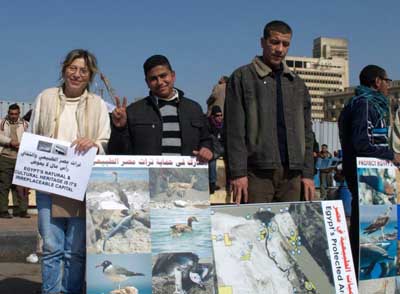
On the right, Dina Zulficar, with other animal advocates, in Tahrir Square
Dina Zulficar, Egyptian animal rights activist, writes, on the occasion of the first anniversary of the Egyptian Revolution, celebrated in Tahrir Square, “A banner, 30 meters long, illustrated the protected 29 areas of Egypt. We gave out many pamphlets with slogans, three big posters illustrating wildlife and a map showing the protected areas. People of many different ideologies responded. We ended up being joined by a great many supporters!
“Gabriel Mickael, bio-engineer, is the one who called for the event, and made the 30- meter banner.” Prominent Egyptian environmentalists were present, as well, at the celebration.
To visit the Facebook page of AWAR, the organization founded by Dina Zulficar, click here.
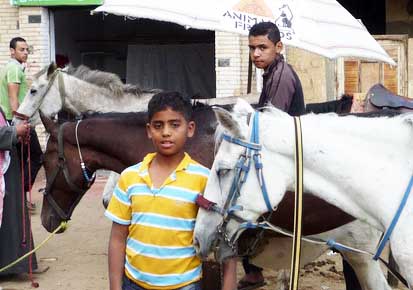
Ahmed El Sherbiny, Chairperson of ESAF (the Egyptian Society of Animal Welfare) writes: “Since 2005, ESAF has conducted a weekly clinic in the Pyramids area for horses, donkeys, and now camels. However, after the revolution [when the horses were starving first due to civil unrest and the curfew, then because of the collapse of tourist trade income], we increased the clinic to three times a week and included feeding….
“As part of our long-term plan, ESAF has now opened a permanent clinic, not far from the Pyramids. This clinic operates seven days a week, from 9 am till 5 pm, providing both feeding and treatment for horses and camels in need.
“ESAF operates a weekly stable visit for the horses that are unable to attend either the clinic or the shelter; there is no charge for this service.”
To visit ESAF’s Facebook page, where you can offer to help the Pyramids horses and camels, click here.
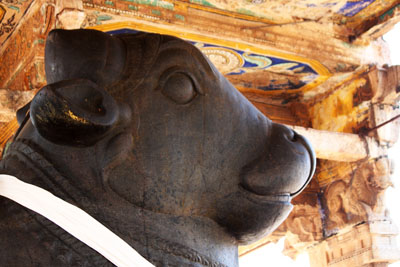
At Brihadeshwara Temple in Tamil Nadu, Nandi, the sacred bull, guards the entrance, just as he has guarded the entrances to all Shiva temples for thousands of years. Like the cow, the bull has always been revered and honored in India.
In modern times though, there have sprung up more recent “traditions”, such as sporting events (some known as jallikattu) in which bulls are forced to participate and which are very cruel to them. It is sad to see this happening in India, since it goes against the time-honored respect that India holds for all life.
Within a couple of days there will be a court case to determine whether bulls should be used in these various kinds of sporting events in the southern state of Tamil Nadu. All these events, like bullock cart racing and jallikattu, subject the bulls to suffering and abuse. It is not natural for bulls to race, so they must be mistreated to get them to run.
A few months ago, the Hon’able Jayanthi Natarajan, one of the ministers of Tamil Nadu, was instrumental in passing a ruling that bulls should not be used in sports events as performing animals. However, as you can imagine, those who are profiting from using the bulls in races, would like to continue these events, and they have been very active in making their voices heard. So it would be helpful if all of us can make known our wish that the bulls should be treated with kindness, respect, and compassion and not be used in racing, which is inhumane.
Please send an email, thanking the Minister for the ruling she issued banning bulls from being used as performing animals and expressing your wish that bulls may continue to be protected from having to participate in any sporting events. Below is the letter that I sent. Please use the same form of address, but please do not use my words, since it will be more effective to use your own words. The points made can be the same. The email address is mosefgoi@nic.in Thank you for taking this step to help the bulls in India.
Hon’ble Jayanthi Natarajan
MoS(I/C)
Ministry of Environment & Forests
Government of India
Dear Hon’ble Jayanthi Natarajan,
I was very happy a few months ago to learn that your Ministry had issued a notification banning the use of bulls in performing.
This is an extremely important issue because India is known throughout the world as a country that respects animals, especially cows and bulls, who are so abused in much of the world, for example, by being slaughtered for food.
It is essential that India set an example for the rest of the world by ensuring that bulls are never used in any kind of sports events, races, or contests, or in any similar ways that could cause suffering to them.
Bulls must be honored, respected, and allowed to live in peace.
Only by honoring and caring for animals can we as humans create a society where there is peace and well-being.
Thank you for ensuring that bulls in Tamil Nadu will be safe and well-cared for and for preserving and protecting the noble traditions of India, which always show kindness to animals.
This link will take you to a wonderful, absolutely charming video spoof, by Greenpeace India, sung by a tiger and a bear, to protest the destruction of forests in central India, by coal mining.
To help save these forests and the tigers, bears, and other animals who live there, please watch the video, then sign the petition (at the link above) — then to become a citizen of Junglistan, go to http://www.facebook.com/greenpeaceindia?sk=app_294481920590355
In October, Veterinarians for Animal Welfare in Zimbabwe, got a call from someone worried about a neighbor’s litter of puppies. They went to investigate and found three four-month old puppies in good shape. But a fourth puppy was lying listlessly on his side. He managed a tiny wag of his tail, but that was the best he could do.
The owner of the puppies came out of the house and explained that she wanted to keep the three healthy puppies, but that she had no use for the little sick one. Sadly, the puppies’ mother had died giving birth.
Sam, as he came to be called, was literally at death’s door. His little front legs were crooked, he was starving, and he could barely move. They took him straightway to the Chisipite Vets, where it was discovered that he had a serious medical condition as well.
Thanks to the very dedicated treatment he received, he not only survived, but he now looks like a different pup altogether. His legs straightened out, his fur grew, and despite his sad beginning, “He loves everyone he meets.” Now healed, Sam is looking for his forever home.
Meryl Harrison, Chief Animal Welfare Inspector, who never seems to stop, saves countless animals from cruelty cases. She gained a reputation a while back for intervening, with remarkable courage, during some of the farm invasions in Zimabawe to save the animals. Now she rescues donkeys and cows from cruelty, seeing to it that those who abuse animals are prosecuted. VAWZ saves a great many dogs that find themselves in really difficult situations.
To read more about the work being done by this remarkable group, click here.
Kavita and her husband, Satish, take care of several strays in their bunglow in Nandivali Road. PAWS each year vaccinates all their strays free! Kavita and Satish named this little one ‘Snow White.’
Snow White got adopted on Christmas day! Many such orphaned, roaming pups need a caring home, Instead of buying a foreign breed, adopt an animal from our rescue center! The care fact sheet and vaccination will be provided by PAWS! Don’t buy while homeless animals die! Call PAWS at 9820161114 for further information.
Wishing all a Merry Christmas and all animals in your care a happy and safe holiday!




 Art, animals, and the earth