Man Lives Alone in a Radioactive Town to Care for the Abandoned Animals

GarryRogers's avatarGarryRogers Nature Conservation

Source Ecorazzi
By Brianne Hogan

Naoto Matsumura has refused to leave the radioactive town of Fukushima, Japan in order to take care of its abandoned animal residents.

Fukushima was evacuated in 2011 after an earthquake and a tsunami caused a radioactive meltdown from its nuclear power plant.

Approximately 30,000 residents left the town, leaving behind their animals, including pets and livestock.

Matsumura, a farmer, had initially fled with his family, but because it was difficult finding adequate accommodations, he decided to return to Fukushima. It was upon his return when he realized the town’s animals had been abandoned and were in need of much-needed care. Animals had starved to death in their barns, or chained up without food or water.

“I had no choice but to stay,” Matsumura told Vice. “I couldn’t leave the animals behind. They needed to be fed.”

Source: our-compass.org

GR:  Wildlife surveys found that wild animal…

View original post 47 more words

Wolf back in the Netherlands, after over two centuries

petrel41's avatarDear Kitty. Some blog

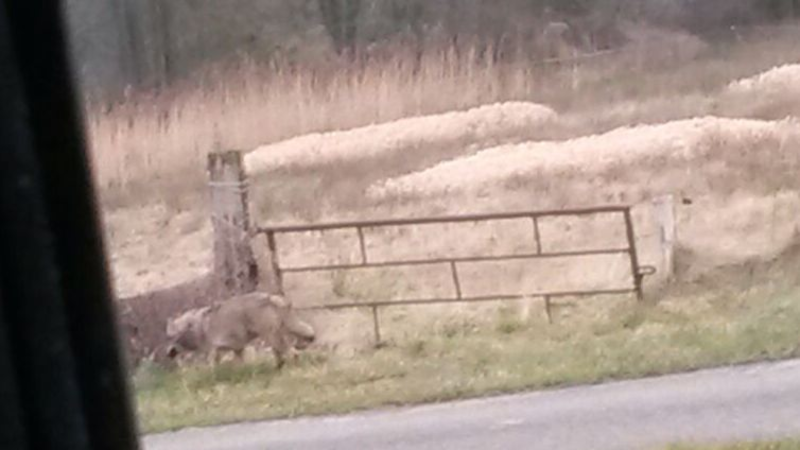
Wolf of Noord-Sleen, photographed from a car

Translated from NOS TV in the Netherlands today:

The wolf is back in the Netherlands, says the foundation Wolves in the Netherlands. This morning the animal was spotted and photographed near Noord-Sleen, in the province of Drenthe. According to wolves expert Leo Linnartz there is no doubt. “It’s the same wolf as the last days was seen near the border with Germany.”

German colleagues of Linnartz informed him in recent days that the wolf was on its way to the Netherlands. “It was no surprise that this morning we received the message that one was seen.”

Linnartz is sure that the photos he has seen are real. “There is no indication that the story is not true. It’s all very reliable,” he says.

See also here. And here. And here. And here.

This 5 March 2015 video shows a wolf in Germany…

View original post 115 more words

Wolf in the Netherlands was wild German wolf

petrel41's avatarDear Kitty. Some blog

This Dutch video is about Wolven in Nederland. This organisation prepares for when wolves will come back to the Netherlands, trying to prevent human-wolf conflicts.

Translated from the Wolven in Nederland site:

The wolf which wandered in early March through Drenthe and Groningen provinces comes from a pack of wild wolves in Germany. It is a young animal from the “Munster” pack in the region of Hamburg-Bremen. This is shown by DNA analysis.

Early this month, the Netherlands was fascinated by a wolf of unknown origin, which for a few days ran through Drenthe and Groningen. The animal appeared regularly and behaved not exactly in a shy way. Research shows that it nevertheless was a wild wolf.

View original post 33 more words

European toad winking its eye, video

The Modern Savage: A New Book Questions Why We Eat Animals

Exposing the Big Game's avatarExposing the Big Game

https://www.psychologytoday.com/blog/animal-emotions/201504/the-modern-savage-new-book-questions-why-we-eat-animals

There’s a good life beyond beef and after meat

Dr. James McWilliams (link is external)‘ new book called The Modern Savage: Our Unthinking Decision to Eat Animals (link is external) is a very thoughtful work about our meal plans in which he covers the ecological and ethical reasons for not eating nonhuman animals (animals), and shows that labels such as “cage free,” “free range,” and “humanely raised” are not necessarily sound and ethical (the Kindle edition can be found here (link is external)). Furthermore, more “personal” backyard farming in which humans form close relationships with other animals who are usually named before they’re killed for food also raises deep ethical questions.

The book’s description captures what Dr. McWilliams’ book is all about: “In the last four decades, food reformers have revealed the ecological and ethical problems of eating animals raised in industrial settings, turning what was once the boutique concern…

View original post 518 more words

Six solutions for transforming your balcony into a biodiversity sanctuary

GarryRogers's avatarGarryRogers Nature Conservation

Your balcony – a little corner of paradise…

Source: livingcircular.veolia.com

GR:  If you live in North America, here’s a good source for beekeeping information:  http://www.beeculture.com/directory/find-local-beekeeper/.  Beekeeping associations in other parts of the world are listed here: http://honeyo.com/org-International.shtml.  You can find more information through the one of the beekeeping forums.  Interested?  It takes about 30 minutes per hive per week, and 2 hours per hive twice a year to extract honey.

View original post

Critical conference maintains global momentum to curb wildlife crime

Critical conference maintains global momentum to curb wildlife crime

wildlifenewsuk's avatarWildlife News

http://wildlifenews.co.uk/wp-content/uploads/2014/11/rhino.jpg – Heads of State, ministers and officials from 31 governments meeting today in Kasane reaffirmed their determination to scale up their response to the global poaching crisis, and adopted crucial new measures to help tackle the unprecedented surge in illegal wildlife trade.
During the one-day… – http://wildlifenews.co.uk/2015/03/critical-conference-maintains-global-momentum-to-curb-wildlife-crime/

View original post

Black-tailed godwit feeding, video