Zambian High Court overturns government mining plan in Lower Zambezi
February 2014: A plan to mine copper from the Lower Zambezi National Park has been halted by the High Court in Lusaka, Zambia, despite gaining government approval. In January the government granted approval for Mwembeshi Resources Ltd to mine up to 80 million tonnes of copper ore from the park per year despite protests by Zambian environmental organisations.
The park is an Important Bird Area and is being considered for listing as a World Heritage Site and these groups are concerned that such a massive project could have serious impacts on biodiversity, water and people downstream.
“As a unique and world renowned ecosystem with immense financial and ecological value to Zambia, the area deserves the highest form of protection,” said Mr. Moses…
This is the first e-newsletter from Working For Animals and I want to say thank you for all your support. Because of you we have been able to save the lives of thousands of animals in the foothills of the Eastern Himalayas, in the towns of Kalimpong and Darjeeling, and in the remote villages, tea gardens, and hamlets of Darjeeling District.
I am writing this newsletter from Kalimpong Animal Shelter where I have been staying for the past month. I am so proud to see the way this shelter has grown. Checking the summaries of reports, I see that since its inception in 1995 the shelter has spayed about 7000 dogs, vaccinated 25,000 animals against rabies and given over 61,000 treatments, mostly to dogs and cats, but also to goats, pigs, rabbits, cattle, horses, hens and even monkeys and donkeys. In the past year, the Darjeeling Shelter has carried out a total of 687 dog spays and 129 animal rescues… In total KAS (a bigger shelter) gave 8054 treatments in the last year, and DAS treated 4813 animals: all this despite numerous political strikes and closures, long distances to travel to distant villages, and the rising cost of fuel to conduct the camps.
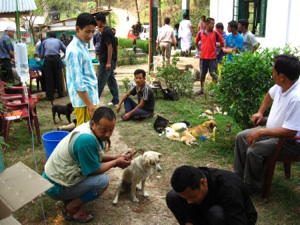
An ABC Camp at Kalimpong Animal Shelter
At KAS, there are almost two acres of gardens in which the kennels, dog-runs, operating theatre, office, dispensary, vet’s house, volunteer’s hut, manager’s house, and kitchen are located, as separate buildings. There is enough room for many of the healthy dogs to be free during the day, although ABC (animal birth control) dogs are kept kennelled before and after the key-hole flank spay, and anti-rabies vaccination. When recovered, they are put back on the street in the place they were caught.
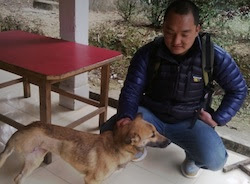
One of Bhuti’s owners collects her.
A HAPPY ENDING
Among the many cases which I saw treated, one in particular stands out. A small brown dog, named Bhuti, was brought to the shelter by two Buddhist monks from Pedong, a journey of at least a couple of hours. ‘We accidentally ran over this dog’, they said, ‘Do anything, but please save her life’….
Dr. Deo Pandey, and volunteer vet from Sweden, Dr. Christoffer Westin, examined the dog.
Christoffer and Deo together carried out the long and difficult operation. A follow-up operation of a skin graft was also required. After a month, the monks came to collect Bhuti. She was completely recovered, and was managing well on one back leg.
For more information on the work of the shelters, click here.
January 2014: A tracking device, which weighs less than a paperclip, has helped scientists uncover one of the world’s great bird migrations.
It revealed that red-necked phalaropes in Shetland migrate thousands of miles west, across the Atlantic to the Pacific Ocean; a journey never recorded for any other European breeding bird.
In 2012 the RSPB, working in collaboration with the Swiss Ornithological Institute and Dave Okill of the Shetland Ringing Group, fitted individual geolocators to ten red-necked phalaropes nesting on the island of Fetlar in Shetland, in the hope of learning where they spend the winter.
When the birds returned to Shetland experts discovered it had made an epic 16,000 mile round trip – from Shetland across the Atlantic, south down the eastern…
A Quiet Moment in the Snow—With a Very Large Eagle
Our Multimedia program is working on a documentary about the great sagebrush ecosystems of the American West. Tying together the many strands of that story is one of the region’s top predators, the Golden Eagle. On a filming expedition last fall, as a morning snowstorm descended on the gray-green plains of Wyoming, we captured a brief moment with one of these majestic predators.
January 2014: wildlife cameraman and natural history presenter, Gordon Buchanan will talk to the Holyrood Petitions Committee about getting the golden eagle adopted as Scotland’s national bird: here.