Uttarakhund: help still needed for flood-stranded mules, donkeys, and horses

PFA Dehradun flood relief team treating one of the horses

On June 16, enormous floods cascaded through Uttarakhand in northern India, sweeping away thousands of people and devastating the beautiful countryside in the foothills of the Himalayas.

Several of India’s most holy temples are found there, including Kedarnath, which was left still standing, but severely impacted with many feet of mud, and many deaths in and around the temple.

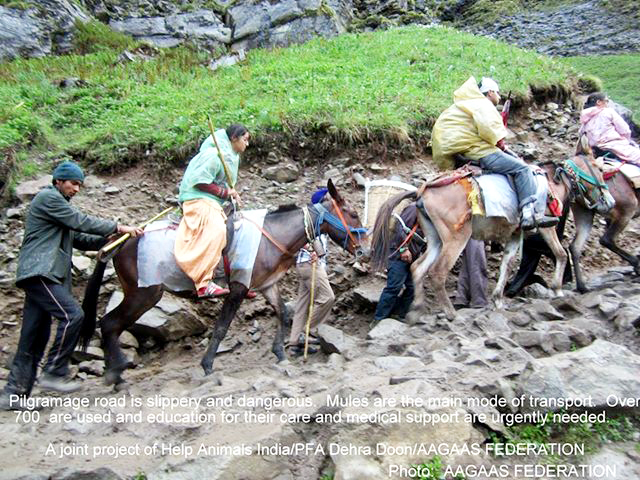
Among the casualties in the area are thousands of mules, donkeys, and horses who carried pilgrims up the steep mountains to the sacred sites.  Many animals died in the floods and others, sadly, have died since in the flood’s aftermath, as they sought food and safety higher up on the precarious mountain slopes. However, thousands of mules and other equines remain stranded, in urgent need of help, on the far side of the rivers, including the Alaknanda River.

All the bridges on this section of the river were destroyed in the floods. The animals need to be led to safety across temporary bridges, and there is an immediate need for helicopters to air-drop fodder to them. Some animal fodder has been provided, but only a fraction of what is needed.

Several animal organizations are helping, including Humane Society International, PFA Uttarakhand, PAL Thane, PFA Dehradun, Animal Ashram, Help Animals India, and others.  The following information is from PFA Dehradun, one of the groups assisted by Help Animals India.

Horses carrying pilgrims on the route up to Kedarnath, before the floods

Recent news

Starting with the most recent news – on July 3, 2013, Manavi Bhatt, of PFA Dehradun, wrote that the government has now begun building a temporary bridge for the evacuation of the animals. Earlier, on June 26, the army had built an iron foot bridge at Lambagarh. PFA Dehradun had been asking the District Minister of Chamoli to deploy the army to build a bridge across the River Alaknanda near Hemkund Trek, a 15,000 foot high sacred site, with a glacial lake surrounded by seven mountains, where many animals remain stranded.

Two days earlier, on Monday, July 1, Manavi Bhatt wrote “The situation on the Hemkund Trek is getting more and more critical by the day.” 1500 animals are stranded at Hemkund Trek, including 350 that PFA volunteers found stranded in Pulana Village, where “not a single air-drop of animal fodder has been done there as of today.”

Nearby Ghangaria serves as a base camp for travelers going to Hemkund or to the Valley of Flowers.  There are animals stranded there too without food.

Kedaranath horses before the floods

Tons of animal fodder are lying at airports, but with bridges and roads washed out, logistics of getting it to the animals are difficult. Helicopters need to be requisitioned.

The area is filled with many rivers of rushing water and very steep terrain.  Most of the stranded pilgrims have been evacuated, though there remain the bodies of the dead to be collected, and there are villages higher up where people are still in need of help. Some of the local guides have stayed behind with their stranded animals.

On June 29, Manavi Bhatt wrote that PFA Dehradun volunteers Pankaj Pokhriyal, Jasbir Singh, and others were reporting from the scene of the disaster that evacuating the animals is essential. There are very large numbers of mules and horses, and the minimal amount of food that is reaching them cannot continue to be supplied. No food has reached the animals stranded higher up on the slopes. She expressed her thanks to Animal Ashram of Lucknow for transporting fodder, at their own expense, all the way from Lucknow (in Uttar Pradesh, just south of Uttarakand) to feed the animals.

Relief team

On July 26, a joint Team of Raahat Veterinary Hospital (PFA Dehradoon) AAGAAS Federation and PAL Thane, supported by Help Animals India, set out to conduct extended relief operations for the working animals in the Chamoli District, Uttarakhand. There had been a prior plan already in place to help the animals who work so hard going up and down the trails carrying the pilgrims, and an on-the-ground assessment had been done prior to the floods.

It’s not easy for someone who’s never been there to form a clear picture of where the sites are and of the situation.  All disaster are difficult, and this one is no exception.  Stressed and overwhelmed government authorities are trying to help the humans as a priority.  Animal groups are struggling heroically to help thousands of animals, with meager resources, not enough government help, difficult communications, dangerous rushing rivers, and the nearly insurmountable challenge of trying to get helicopters to air-drop fodder, and temporary bridges built to evacuate the mules, horses, and donkeys.

Help still needed

Help is still much needed, and animal groups continue to do exhausting work to get food and medical care to the animals.

To give a donation or sign a petition, here is the website of Help Animals India (caution – disturbing photos).       

To read this and other news, here is the Facebook page of PFA Dehradun (caution – disturbing photos).

Top photo: Courtesy of PFA Dehradun / Food relief team treating one of the horses. 

Second photo: anarupa_chowdhury / Wikimedia Commons / “This file is licensed under the Creative Commons Attribution 2.0 Generic License.”/ Horses on the route to Kedarnath, before the floods. 

Third photo: Samadolfo / Wikimedia Commons / This file is licensed under the Creative Commons Attribution-Share Alike 3.0 Unported license. / Horses on a hill near Kedarnath, before the floods, July 3, 2011.
Floods in Uttarakhand: Help on the way for injured working animals

mules in Uttarakhand resized 1017586_534151963313888_155430785_n


Monsoon rains in Uttarakhand have been heavier than at any time in the past 60 years, and floods have killed over 500 people. 5,000 are still missing, and the death toll is expected to rise.  Buildings have been toppled and swept away, as well as entire villages and settlements.


The flooding has also devastated parts of Nepal and the Indian states of Himachal Pradesh, Haryana, and Uttar Pradesh, as wells as Delhi.  These areas are in the far north of India, near the foothills of the Himalayas—a spectacularly beautiful area of forests and snow-covered mountains, where there are major Hindu sacred sites and temples.  Many thousands of visiting pilgrims have been caught in the floods, which have swept away bridges and roads.


Sadly, a great many animals have also died or been hurt in the rushing water. 5,000 mules, horses, and donkeys who transport pilgrims up and down the steep, rocky slopes, are now stranded on the far side of the Alaknanda River, one of the headstreams of the Ganges. Most are mules, and, as well as needing feed and clean drinking water, some are injured, and in urgent need of veterinary treatment.


Another 100-200 mules on this side of the river will soon be taken to the small town Josimath.


Help Animals India is working with their two partner organizations to bring help to both people and animals stranded by the floods.


Help Animals India’s partners, PFA Dehra Doon and AAGAAS Federation, have reported that a temporary bridge has been constructed and that authorities are now evacuating all the stranded pilgrims across the river.  As soon as this has been completed, if all goes well, PFA Dehra Doon and AAGAAS Foundation will be able to start transporting the injured mules to safety, and giving them urgently-needed veterinary care, medicine, feed and water.


Help Animals India, for the past several years, has worked with many Indian animal welfare groups, benefiting thousands of animals.


Eileen Weintraub, Founder and Director of Help Animals India writes, “We are doing our best to help the “Himalayan Tsunami” with many hundreds of people dead and thousands still stranded. We are buying medical supplies as well as ropes, tents, sleeping bags, rucksacks and tarpaulin to go in and access the situation to rescue and treat as many as possible of the hundreds of abandoned equines – horses/donkeys/mules. We will have to get through this next round of rain and the full moon, and this coming week will start the relief efforts for the survivors …On the ground are our trusted partners PFA Dehra Doon and AAGAAS Federation and volunteers coming up from Mumbai… Every penny will go towards the relief effort. Thank you for your compassion during these difficult times.”


Donations to Help Animals India are U.S. tax-deductible.


To donate through the website of Help Animals India, click here.


To visit Help Animals India’s Facebook page, click here.


To visit the website of  PFA Dehra Doon, click here.


To visit the website of AAGAAS Federation, click here.


Photo: Courtesy of AAGAAS Federation / This was taken before the current floods.


U.S. Wildlife: Help Lesser Prairie-Chickens Stay Safe and Keep Dancing

500px-Lesser_Prairie_Chicken,_New_Mexico

By Taylor Jones, WildEarth Guardians

(Reposted from WildEarth Guardian’s newsletter, without the internal links.)


These amazing little western grouse have waited over a decade for the much-needed protections of the Endangered Species Act. The imperiled lesser prairie-chicken has already lost 90 percent of its historic habitat and its population is only 15 percent of what it once was.  Tell the U.S. Fish & Wildlife Service you support giving these fascinating birds the full protection of the law! Comments are due on the 20th, so make your voice heard now!

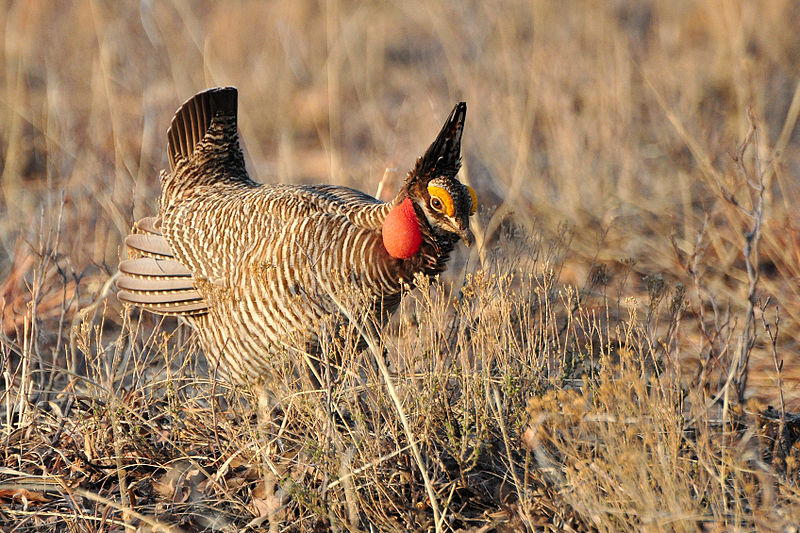
Lesser prairie-chickens are famous for their mating dance, when they show off their bright yellow eye combs, inflate red air sacs on their necks, and spar in mid-air. In celebration of their proposed listing, which may at last furnish them with strong legal protections, they are doing the “Safety Dance!”

The lesser prairie-chicken’s amazing displays aren’t protected yet, though. The Service also proposed a “special rule” that would allow habitat destruction to continue in certain cases, potentially allowing weaker state plans or conservation agreements to supersede the ESA.  The Service may even allow hunting of lesser prairie-chickens, or the “incidental take” of the birds during the hunting season for their cousins, the greater prairie-chicken. These exceptions are entirely inappropriate for a species facing so many threats, including oil, gas, and wind energy development, collisions with fencing, drought, overgrazing by livestock, and habitat fragmentation.

Help put safety first – let the Service know you support the strongest ESA protections for the lesser prairie-chicken and oppose any “special rule” that would undermine their survival and recovery.  Advocate for these intriguing birds – help keep them safely dancing!


For the Wild,

Staff_Photo_Taylor_Jones_r.1

Taylor Jones

Endangered Species Advocate

WildEarth Guardians

tjones@wildearthguardians.org


To sign the letter, on the WildEarthGuardians website, on behalf of Lesser Prairie Chickens, click here.


Photo: Wikimedia Commons / “This image was originally posted to Flickr by Larry1732 at http://flickr.com/photos/22191277@N03/5644328619. It was reviewed on 24 April 2011 by the FlickreviewR robot and was confirmed to be licensed under the terms of the cc-by-2.0.” / “A Lesser Prairie Chicken (male) in new Mexico.”


LEBANON: BETA’s 6th Annual Dog Show

poster resized

By BETA (Beirut for the Ethical Treatment of Animals)

(Reposted.)

Dear friends,

Pawstively Wag’licious, BETA’s 6th Annual Dog Show will be held on Saturday, June 29th this year. Mark your calendar and join us at the Beirut Hippodrome for a fun day to spend with your human and canine family!

Kids games, delicious foods and snacks for all, refreshments, and music… And this year, we also have the pleasure of welcoming Beirut Juggles, where there won’t be any spectators, only performers of all ages!

This is the only event of its kind in the country! So get ready for a fun day… Where obedience is just a tale.

All proceeds of the Dog Show will go directly to benefiting animals in Lebanon.

May the loudest, oddest, smartest and prettiest dogs win!…


To visit BETA’s website, click here.


Costa Rica: Homeless people line up to get their pets spayed/neutered


OLYMPUS DIGITAL CAMERA

By SNIP  (Spay Neuter International Project)

We are very happy to report that we have completed our first two spay & neuter clinics!

COSTA RICA

Barrio Nuevo is one of those poor neighborhoods so common in developing nations. These Barrios originated a while back as shantytowns, a clutter of simple shacks made of flattened oil drums, plywood, aluminum sheets, plastic tarps and whatever recycled construction materials the “developer” was able to put his hands on at the time.

They first attracted the poorest of the poor, most often former Campesinos (farmers) who left the rural areas of their countries for the big city, in hope of escaping poverty and hunger.

In Costa Rica, the capital is surrounded by such Precarios, neighborhoods that were once temporary as their name indicates, but that are now well established components of the Central Valley, where the big city of San José lies.

Junior, a homeless man who calls the streets of Barrio Nuevo his home, is well aware of the challenges that every resident faces. He spends the day looking for work and caring for several of the furry wanderers that follow him around, wagging happily in the sticky tropical heat.

One dog in particular is very attached to him. Bigotica, which roughly translates to “Costa Rican moustache”, decided that Junior needed a guardian angel and takes her role very seriously, never leaving his side. When Junior heard over the Coconut Telegraph – the grapevine, as it is nicknamed around here- that the SNIP Foundation and the Asociación Nacional Protectora de los Animales (ANPA) were organizing the first ever spay and neuter clinic in his neck of the woods, he made sure to be first in line on the morning of the event.

“I know firsthand what the dogs have to do to stay alive here. We need a lot of things in Barrio Nuevo, but one thing we do not need is more puppies suffering in the streets”, says Junior as we check his beloved Bigotica in.

At the end of a very long day, after many Juniors came and left cradling their spayed/neutered pets in their arms, we sat down feeling beat and yet proud of what we had accomplished. Now the challenge is to follow up, continuing with our outreach education efforts and promoting responsible ownership.

To read the rest of SNIP’S newsletter, you can sign up to receive the newsletter at their website. Click here

Photo: Courtesy of SNIP


In a landmark ruling, India bans dolphinariums, Part Two

500pixelswide-Common_dolphin_noaa


To read Part One first, click here.


The threat to the dolphins in India goes back much further though.  In a very tragic turn of events, in 1998, a dolphinarium, Dolphin City, actually was set up in Chennai. CPREEC, Dr. Nanditha Krishna’s organization, and Blue Cross of India, of which Dr. Chinny Krishna was the Co-Founder and, at that time also the Vice Chairman, worked tirelessly to oppose it.


Very sadly, the three dolphins who had been imported from Bulgaria and brought to the Chennai dolphinarium, died within a few short months.  The dolphinarium denied that they had died, and the show went on with only sea lions.


In reply to all questions, their story was that the dolphins were okay, and would soon be performing “when they were alright.”  Dr. Chinny Krishna, of Blue Cross, persisted in telling the truth about the fate of the dolphins and in calling for an autopsy. Finally, a reporter from the Hindu confronted the dolphinarium’s management stating that if he was not allowed to see the dolphins, he would be forced to agree with Blue Cross’s statement that they had died.  The truth of the dolphins’ deaths did come out.  But, in the meantime, the dolphinarium had not only denied the dolphins’ deaths, but had ordered three more replacement dolphins from Bulgaria and arranged for their transport on a Russian plane, to be parachuted down from the plane on to the coast of Tamil Nadu, near Chennai.  After the story broke in The Hindu, massive negative publicity erupted all over Chennai, forcing the dolphinarium to shut down — fortunately, this happened before they could import the three new dolphins. Sadly though, the sea lions, by this time, had also died.


In the midst of this overwhelmingly tragic story for the animals, Dr. Nanditha Krishna recalls a somewhat lighter moment — someone arrived carrying a “whole box full of rupees.”  They thought they could bribe the Krishnas to keep quiet and forget all about the dead dolphins.  Of course, the people were sent away in short order, taking their overstuffed box of rupees with them.


The Chennai dolphinarium was closed, thanks to the determined efforts of Blue Cross and CPREEC.  Another attempt, just last year, to set up another one, in Mumbai, was also thwarted.  With the ban just announced, India will be permanently free of the cruelty inherent in keeping dolphins in captivity.


?????????????????????????????????????????????????????????????????


Dr. Nanditha Krishna explains, “Dolphins belong to the ocean, just as other wild animals belong to the forest.  Every species belongs in their own natural habitat. They have lovely smiles. They are so innocent. How can it be right to confine a dolphin and make them do performances?”


The system of animal protection laws in India is perhaps the most enlightened anywhere in the world; it has been put together over decades by many far-sighted leaders across India in the animal welfare movement.  Even more significantly, it flows from the deep reverence for animals which, over the millennia, has been and still is part of the fabric of Indian life and culture.


?????????????????????????????????????????????????????????????????????????


The permanent ban issued by the Ministry of Environment and Forests, Dr. Chinny Krishna believes, will put a definitive end, in India, to attempts to remove dolphins and other cetaceans from the sea and use them for human entertainment.  “In the wild, dolphins live 40 or 50 years.  In captivity, they may die in two or three years.  If this isn’t cruelty, I don’t know what is.  In India, this unkind captivity won’t be happening. Dolphins need to enjoy their freedom and their beautiful wild lives in the sea.”


In banning dolphinariums, India has, once again, led the way towards compassionate protection for animals.


If you’d like to write to thank Ms. Jayanthi Natarajan for this landmark ruling banning dolphinariums in India, you can write to her at


Ms. Jayanthi Natarajan

Minister of Environment and Forests

Government of India

Email: mosefgoi@nic.in


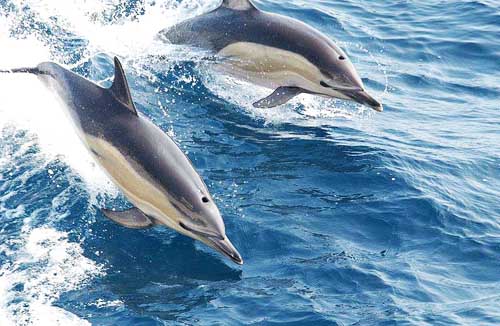
Top photo: “This image is in the public domain because it contains materials that originally came from the U.S. National Oceanic and Atmospheric Administration, taken or made as part of an employee’s official duties.” / Wikipedia Commons / Common Dolphin


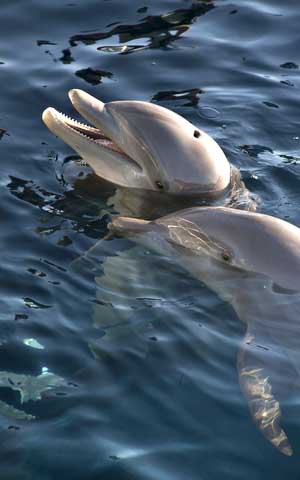
Second photo: © Lemonpink / Dreamstime.com / Two dolphins in the sea


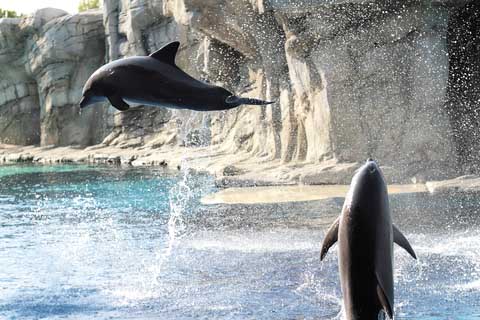
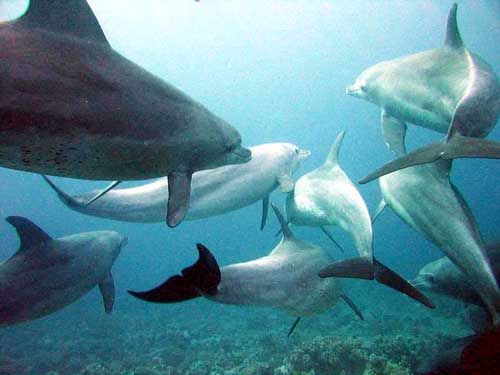
Third photo: © Cancer741 / Dreamstime.com / Dolphins in nature


In a landmark ruling, India bans dolphinariums, Part One

500pixelswide-Bottlenose_Dolphin_KSC04pd0178

In a landmark ruling, India bans dolphinariums, Part One

“The sun was shining. The dolphins were like silver and gold streaks, jumping up out of the ocean, near the boat. They have synchronized movements, and they jumped together, making great arcs in the shape of a bow.  Their sheer beauty was amazing.  It was beautiful.  They’re so innocent.  How could anyone mistreat them?”

Dr. Nanditha Krishna recalled seeing dolphins in the wild, in the Andaman Sea, when she was traveling by ship from Singapore back to Chennai, India. She was captivated by them, and it is a memory that has stayed with her.  Dr. Nanditha Krishna is the Honorary Director of the CPR Environmental and Education Centre (CPREEC). Dr. Chinny Krishna, who has devoted his life to the wellbeing of animals, serves as the Vice-Chairman of the Animal Welfare Board of India.

Just this month, in an outstanding victory for dolphins, India has banned dolphinariums from being set up anywhere in India.  On May 17, 2013, Ms. Jayanthi Natarajan, the Minister of Environment and Forests (MoEF), issued this decisive ban. This means that these beautiful, gentle creatures will not be exploited in India. Dolphins that are held captive in dolphinariums are wild animals who have been taken from their lives of freedom in the oceans to be used for human entertainment. Other countries are likely to follow this forward-looking, compassionate stand.

Mr. B.S. Bonal, Member Secretary of the Central Zoo Authority, in an accompanying statement, expressed the view that dolphins are to be regarded as “non-human persons.”

500piselswide-Dolphins_gesture_language

In accordance with the Wildlife Protection Act, 1972, all zoos in India, a category which would include dolphinariums, must obtain advance permission from the Central Zoo Authority before they can be established. Mr. Bonal goes on to state that dolphins are highly intelligent, and that it is morally unacceptable to use them for entertainment; also that they do not survive well in captivity and that they undergo extreme distress when captive.  Therefore on all these grounds, the Ministry of Environment and Forests will not allow any dolphinariums in India.

Dr. Nanditha Krishna points out that this document is remarkable in the annals of animal welfare law, in that it makes the case for the ban on dolphinariums based on the vantage point of the animal, and not from a human point of view, and states explicitly that dolphins are “persons.”

Dr. Nanditha Krishna served two three-year terms on the Central Zoo Authority (CZA) and has over the years been in on-going communication with Mr. Bonal and the earlier Member Secretaries of the CZA.  When the alarming possibility first surfaced around a year ago of a dolphinarium in Kerala, she wrote to  Dr. Tishya Chatterji, the then Secretary of the Ministry of Environment and Forests, Government of India, and Mr. Bonal. Both replied that the Ministry and the Central Zoo Authority would not give permission for these dolphinariums to be set up.  She wrote back that she was very glad to hear that. Mr. Bonal also sent a statement to that effect to the Principal Chief Conservator of Forests in Kerala, telling him to ensure that no dolphinarium came up in Kerala. Finally, in view of the growing demand to ban all dolphinariums, the Central Zoo Authority issued the ban order. This is a bold step forward for freedom for dolphins and other cetaceans.

Earlier, in January, 2013, the Animal Welfare Board of India (AWBI) had issued an advisory, signed by Dr. Kharb, Chairman of the AWBI, much to the same point, strongly opposing the setting up of dolphinariums in India.  All performing animals must be registered in advance with the AWBI, and the advisory  stated that it will not give any permission for dolphinariums, on the grounds that they violate the Prevention of Cruelty to Animals Act, 1960.  Furthermore, the AWBI advisory goes on, there is no educational benefit to seeing cetaceans in captivity.  This can only “mis-educate” the public into not understanding that dolphins are wild animals that belong in the wild.

???????????????????????????????????????????????????????????????????????????????????????????????????????

In accordance with India’s long history of appreciation and respect for animals, a great many Indian groups and individuals worked very hard to keep dolphinariums out of India.

FIAPO, the Federation of Indian Animal Protection Organizations, along with its partners, Born Free Foundation, Global Green Grants Fund, Earth Island Institute’s Dolphin Project, and Wildlife Rescue and Rehabilitation Centre, have also been campaigning against allowing dolphinariums into India.  They have brought public attention to this issue, holding press conferences in Delhi and in Kerala and were very pleased at the announcement of the ban.  Humane Society International has also been actively engaged, non-stop, in fighting against dolphinariums.

It was in the spring of 2012 that the Mayor of Kochi, in Kerala, made the announcement, startling to many, that the city of Kochi was planning to open a dolphinarium.  This sparked animal welfare groups throughout India to work diligently on behalf of the dolphins since that moment.  This success is the result of the work of everyone who took part.

Continued in Part Two

If you’d like to write to thank Ms. Jayanthi Natarajan for this landmark ruling banning dolphinariums in India, you can write to her at


Ms. Jayanthi Natarajan

Minister of Environment and Forests

Government of India

Email: mosefgoi@nic.in


Top photo: “This file is in the public domain because it was solely created by NASA.” /  Wikimedia Commons / “Bottlenose Dolphin – Tursiops truncatus A dolphin surfs the wake of a research boat on the Banana River – near the Kennedy Space Center.”


Second photo: Serguei S. Dukachev / Wikimedia Commons /  “This file is licensed under the Creative Commons Attribution-Share Alike 3.0 Unported license.” /  “Indo-Pacific Bottlenose Dolphin, Tursiops aduncus. Red Sea.”


Third photo: © Caan2gobelow / Dreamstime.com / Spinner Dolphins           


MYANMAR: Determined rescuer creates cat haven

catstwoDSC_0372-1

Ko Cho, who has been rescuing, feeding, and caring for community cats in Myanmar (Burma) for several years, now has a good safe place for some of them to live, in Uranus, his lumber business.  We wish him much success with his business, which will help him in his work with the cats. Ko Cho is the only animal rescuer we are aware of in Myanmar. He also recently rescued and released two young crows, who have stayed around with their cat friends.

catsDSC_0367


Photos: Courtesy of Ko Cho

India: In memory of Smiley

She isn't smiling yet, but she's about to.
She isn’t smiling yet, but she’s about to.


Smiley was a special dog.  All dogs are special, of course, including all the many dogs who have found their way from the streets of Chennai to Dr. Chinny Krishna’s factory, and then from there many have found their way into the home of Dr. Nanditha and Dr. Chinny Krishna.


But Smiley had unique talents.  As well as being charming and endearing, she had a delightful smile – actually a broad grin – which showed all her teeth.  When Smiley was smiling, it was impossible not to smile too.  Dr. Chinny Krishna writes, “She was really the ‘smilingest’ dog I have ever known.”


She was about 7 or 8 when he took her home from his factory in 2006, and she lived to be around fifteen, always active, happy, and in good health.  Even on the morning of May 13, nothing seemed out of the ordinary.


She passed away that afternoon and has gone on to her next adventure, carrying her smile with her to light the lives of friends she meets along the way.


May Smiley rest in peace as she brings peace to others.

Thailand: 50,000 spay/neuters and a tribute to a good friend

sdf_newsletter_may_2013_50000th_dog_with_two_thai_helpersIMG_6202


By Soi Dog Foundation – May 2013 Newsletter


Little black haired Haa Sip (50 in Thai) left his mark on history (and the vets left a mark on him!) when he became the 50,000th animal to be sterilized since Soi Dog started in late 2003. Performing the historic deed were two of our resident veterinarians Dr Su and Dr Che. Haa Sip is from Thepkasatri district in Phuket.

Soi Dog Vice-President John Dalley said the Foundation hopes at its current rate to sterilize 100,000 animals in around three years time. In its first year Soi Dog sterilized just over 1000 animals.

Mr. Dalley said: “The current mobile clinic programme on Phuket, working closely with the province’s local authorities, aims to have the island’s stray population under control in two years and to continue the province’s rabies free status.”

Soi Dog is discussing with the Department of Livestock in Bangkok introducing a national programme based on Soi Dog’s activities on Phuket. Thailand has pledged to eradicate rabies by 2020 in accordance with ASEAN agreements. Large populations of unvaccinated and unsterilized street dogs makes the eradication of rabies virtually impossible and we are hoping that a national programme can be established in the interest of both animal and human welfare.


Tribute to Jeanne Marchig:


Soy Dog dedicated this newsletter to Jeanne Marchig, a generous supporter of Soi Dog Foundation and numerous small animal charities throughout the world, who passed away in early May of this year.


Said Soi Dog Vice President John Dalley at her passing: “We at Soi Dog are extremely saddened to hear of the passing of Madame Jeanne Marchig. Through the Marchig Trust she established in 1989 she has enabled countless smaller animal charities like Soi Dog Foundation to progress and continue their work, and in 2011 she funded the innovative cat hospital that bears her name at the Soi Dog center. Also in 2011 Gill and I were very humbled to receive the annual Marchig trust award for services to animal welfare, one of the most prestigious awards in the world of animal welfare.”

We shall miss her.


To read the rest of this issue of the Soi Dog newsletter, click here. (Caution, some photos may be disturbing.)


Photos: Soi Dog Foundation