Author: sharonstjoan
Poet, writer, and advocate for wildlife, wild lands, and the earth. President, Forest Voices of India - a U.S.-based group which aids charities in India that further education, culture, the well-being of women, children, and animals, and the restoration of sacred groves.
websites:
https://wordpress.com/view/forestvoicesofindia.com
https://wordpress.com/view/echoesinthemist.com
https://wordpress.com/view/wildvoices.world
book: Glimpses of Kanchi
https://www.amazon.com/Glimpses-Kanchi-Sharon-St-Joan/dp/1982901179/ref=sr_1_1?keywords=Glimpses+of+Kanchi&qid=1581769003&sr=8-1
Kangaroo evolution and climate change in Australia

This video is called Mutant Planet- The Evolution of Marsupials.
Talking about Australia and climate change …
From Murdoch University in Australia today:
Kangaroo evolution maps climate change
2 hours ago
The evolution of kangaroos has given a clear picture of Australia’s changing climate, according to a new study.
Murdoch University’s Dr Natalie Warburton and Dr Gavin Prideaux from Flinders University have analysed changes to the kangaroo skeleton over time which reflect Australia’s changing environment and climate.
Dr Warburton said in this way kangaroos represent a sort of barometer for climate change.
“This is important for our understanding of historical climate change in Australia,” she said.
“Our study represents the most comprehensive anatomical analysis of the evolution of modern and fossil kangaroos on the basis of the skull, teeth and skeleton – including some of the new fossil species we recently identified from caves on the Nullarbor.”
View original post 299 more words
Zambian court stops mining in national park plan
This video is called Watching Buffalo in Tongabezi, Zambia – African wildlife.
From Wildlife Extra:
Zambian High Court overturns government mining plan in Lower Zambezi
February 2014: A plan to mine copper from the Lower Zambezi National Park has been halted by the High Court in Lusaka, Zambia, despite gaining government approval. In January the government granted approval for Mwembeshi Resources Ltd to mine up to 80 million tonnes of copper ore from the park per year despite protests by Zambian environmental organisations.
The park is an Important Bird Area and is being considered for listing as a World Heritage Site and these groups are concerned that such a massive project could have serious impacts on biodiversity, water and people downstream.
“As a unique and world renowned ecosystem with immense financial and ecological value to Zambia, the area deserves the highest form of protection,” said Mr. Moses…
View original post 259 more words
Letter to help save 2,000 Mute Swans

2,000 Mute Swans in New York State are being threatened by a plan to kill them, on the grounds that they are harming the natural world. As we know, it is humans, not swans, that harm the natural world. Please read more about this issue on the Friends of Animals website. The link is given below, at the end. And please write a polite letter to help save the swans. Thank you.
Letter sent to
gov.cuomo@chamber.state.ny.us;
NYSDEC Bureau of Wildlife,
Swan Management Plan,
625 Broadway,
Albany,
NY 12233-4754
Dear Madam, Sir,
Please cancel the plan to kill 2,000 Mute Swans in New York State.
Mute Swans and other waterbirds do not destroy habitat. They are part of the natural world — a beautiful, innocent part of nature, and they have every right to live in peace, undisturbed.
I have personally cared for Mute Swans in Utah for many years, and I know them well.
All wildlife must be respected and protected – this is the core principle which forms the basis of all wildlife law. The problems that human beings have in their relationships with nature are caused entirely by humans – by our aggressive and destructive relationship with the planet we live on. These problems will never be solved by killing other species whenever we find them inconvenient.
It is time for us to come to our senses and relate to animals and all of nature with kindness, respect and compassion – to protect wild animals and not kill them.
How can we help ourselves by destroying other forms of life?
Sincerely,
Sharon St Joan
Thank you to Sharon Hopkins for passing on information about this threat to Mute Swans in New York.
To read more about this issue on the Friends of Animals website, click here.
http://friendsofanimals.org/news/2014/january/stop-mute-swan-slaughter-ny
Photo: Author: Geni / File:Mute Swan Emsworth.JPG / “This file is licensed under the Creative Commons Attribution-Share Alike 3.0 Unported, 2.5 Generic, 2.0 Generic and 1.0 Generic license.” / Wikipedia Commons / Mute Swan swimming on Emsworth Millpond
‘Very unexpected’: Researchers discover first new species of dolphin since 1918
Yellow-billed loon in the Netherlands
This is a video of a yellow-billed loon; today, near Rheden in Gelderland province in the Netherlands.
This species is seen more often in Siberia, Canada or Alaska, where it nests, than in the Netherlands.
This is only the 39th yellow-billed ever seen in the Netherlands.
This is another video about the Rheden yellow-billed loon.
See also here.
Related articles


Photo of the Day
AUSTRALIA/INDIA: Excerpts from the newsletter of Working for Animals

By Christine Townend
This is the first e-newsletter from Working For Animals and I want to say thank you for all your support. Because of you we have been able to save the lives of thousands of animals in the foothills of the Eastern Himalayas, in the towns of Kalimpong and Darjeeling, and in the remote villages, tea gardens, and hamlets of Darjeeling District.
I am writing this newsletter from Kalimpong Animal Shelter where I have been staying for the past month. I am so proud to see the way this shelter has grown. Checking the summaries of reports, I see that since its inception in 1995 the shelter has spayed about 7000 dogs, vaccinated 25,000 animals against rabies and given over 61,000 treatments, mostly to dogs and cats, but also to goats, pigs, rabbits, cattle, horses, hens and even monkeys and donkeys. In the past year, the Darjeeling Shelter has carried out a total of 687 dog spays and 129 animal rescues… In total KAS (a bigger shelter) gave 8054 treatments in the last year, and DAS treated 4813 animals: all this despite numerous political strikes and closures, long distances to travel to distant villages, and the rising cost of fuel to conduct the camps.
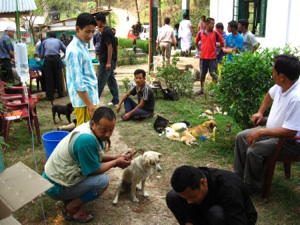
At KAS, there are almost two acres of gardens in which the kennels, dog-runs, operating theatre, office, dispensary, vet’s house, volunteer’s hut, manager’s house, and kitchen are located, as separate buildings. There is enough room for many of the healthy dogs to be free during the day, although ABC (animal birth control) dogs are kept kennelled before and after the key-hole flank spay, and anti-rabies vaccination. When recovered, they are put back on the street in the place they were caught.
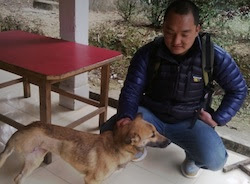
A HAPPY ENDING
Among the many cases which I saw treated, one in particular stands out. A small brown dog, named Bhuti, was brought to the shelter by two Buddhist monks from Pedong, a journey of at least a couple of hours. ‘We accidentally ran over this dog’, they said, ‘Do anything, but please save her life’….
Dr. Deo Pandey, and volunteer vet from Sweden, Dr. Christoffer Westin, examined the dog.
Christoffer and Deo together carried out the long and difficult operation. A follow-up operation of a skin graft was also required. After a month, the monks came to collect Bhuti. She was completely recovered, and was managing well on one back leg.
For more information on the work of the shelters, click here.
Photos: Courtesy of Working for Animals
Egypt: Care for animals at the Pyramids
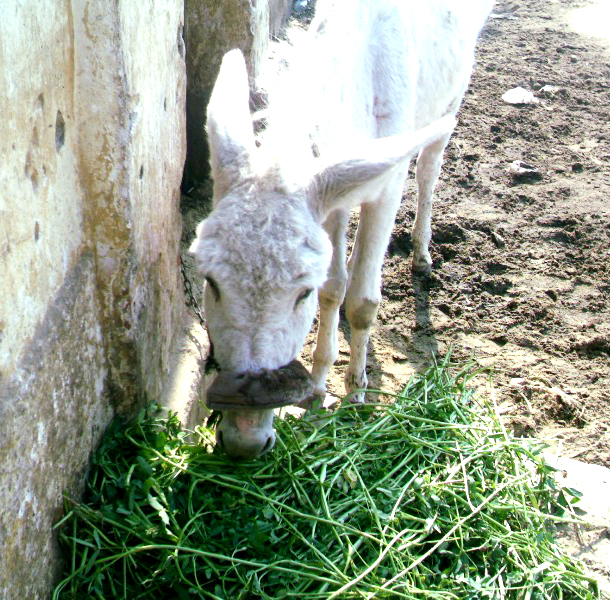
ESAF (Egyptian Society of Animal Friends) held a Pyramids Clinic on Wednesday, January 8 and Saturday January 11, 2014, to provide food and vet care to the Pyramids animals. The horses, donkeys, and camels are used to give rides to tourists, but during times when tourists are few, their owners suffer economic hardship, and the animals need extra help.

ESAF provided fresh greens to the animals, as well as soft nosebands (to replace wire ones), and gave out educational brochures to the owners to improve the care of the animals. The vets treated any injuries and cared for the horses’ hooves and teeth. Around 90 animals were fed and cared for.
Ahmed El Sherbiny thanks Sue Evans for her sponsorship of the Pyramids Clinics.
To visit ESAF’s Facebook page, click here.
Photos: Courtesy of ESAF
Red-necked phalarope migration, new research
This video from Scotland is called Shetland Birds – A Red necked Phalarope on Fetlar.
From Wildlife Extra:
Tiny tag reveals record-breaking bird migration
January 2014: A tracking device, which weighs less than a paperclip, has helped scientists uncover one of the world’s great bird migrations.
It revealed that red-necked phalaropes in Shetland migrate thousands of miles west, across the Atlantic to the Pacific Ocean; a journey never recorded for any other European breeding bird.
In 2012 the RSPB, working in collaboration with the Swiss Ornithological Institute and Dave Okill of the Shetland Ringing Group, fitted individual geolocators to ten red-necked phalaropes nesting on the island of Fetlar in Shetland, in the hope of learning where they spend the winter.
When the birds returned to Shetland experts discovered it had made an epic 16,000 mile round trip – from Shetland across the Atlantic, south down the eastern…
View original post 248 more words
 Art, animals, and the earth