1978 – Rhesus Monkeys – stopping their export for research

sharonstjoan's avatarEchoes in the Mist

709px-Macaque_India_4

By Sharon St Joan

This is one of a series of stories about the early days of the animal welfare movement in India.

In March 1978, the Illustrated Weekly of India published an article by Nanditha Krishna, “Slaughter for Science,” about laboratory experiments on animals that were being carried out in India.

Nanditha Krishna had gained access to the King Laboratory in Chennai simply by calling them up, explaining that she was working on an article about animal research in laboratories, and asking if she might come by to learn more about the scientific work they were doing. She spent a couple of days at the laboratory. She expressed interest in their work, and they were cordial.

The article she wrote contained real and graphic examples of research on animals, from King laboratory and many other sources, as well as statements by medical authorities.

It began with Dr. Krishna’s own…

View original post 1,268 more words

Forest cover increases thanks to urbanisation and Chinese tree planting

Forest cover increases thanks to urbanisation and Chinese tree planting

wildlifenewsuk's avatarWildlife News

http://wildlifenews.co.uk/wp-content/uploads/2015/04/greening-savanna-csiro-400×300.jpg – Despite established tropical forests still being cleared and logged the total forest cover of the planet has increased. This is mainly due to the urbanisation of Russia and the massive tree-planting programmes in China.
A new study has established that since 2003 the global forest and vegetation… – http://wildlifenews.co.uk/2015/04/forest-cover-increases-thanks-to-urbanisation-and-chinese-tree-planting/

View original post

1965 – The first anti-vivisection seminar in India

sharonstjoan's avatarEchoes in the Mist

Rukmini_Devi

By Sharon St Joan

This is one of a series of stories about the early days of the animal welfare movement in India.

In 1965 Blue Cross of India sponsored the first anti-vivisection seminar ever held in India.

Diana Hamilton Andrews, a leading British animal advocate at the time, wrote a report on the seminar, which she had flown to India in order to attend. “Even at 9:30 in the morning,” she wrote, “It was almost unbearably hot, and I was grateful for the fans which whirred in the ceiling.” She describes the women wearing brilliant saris and brightly-colored flowers in their hair – all so very different from the snow-covered London airport she had left the day before.

The Chief Minister of Madras, the Hon. Sri M. Bhaktavatsalam inaugurated the seminar, and Srimathi Rukmini Devi, the Chairperson of the Animal Welfare Board of India, presided.

captain

Captain V. Sundaram, President…

View original post 787 more words

The Rare Bird That Makes The News

Organikos's avatarOrganikos

CHESTNUT-BREASTED__2365682r RARE FIND: Chestnut-breasted Partridge. Photo: Gururaj Moorching.

We most love the online edition of the national Indian newspaper, The Hindu, for its occasional willingness to put news like this on the same footing with the “noise” of the more typical “real” news:

Bengaluru shutterbug captures rare Partridge

Mohit M. Rao

Immense patience and a stroke of luck granted wildlife photographer Gururaj Moorching a two-minute encounter with the rare bird.

View original post 257 more words

More Dutch birds information on the Internet

petrel41's avatarDear Kitty. Some blog

This video from England says about itself:

Common Redshank (Tringa totanus)

22 October 2014

‘Dancing on a pontoon’. Filmed at New Brighton, Wirral, UK, on 21st October 2014 with a Canon PowerShot SX50 HS.

Translated from the Dutch SOVON ornithologists:

Monday, April 6th, 2015

How are lapwings in Friesland? And what is the breeding success of the Dutch buzzards? Information that can be found since this week on the website of sovon.nl. On the website part vogelinfo Sovon now also presents data at the provincial level.

Birders who are curious where most redshanks can be found in their province and whether the black-tailed godwits are increasing or decreasing in their environment, can now easily find information online. Based on bird counts by more than 9,000 volunteers, Sovon can not only at national level tell a lot about the birds, but we also present data by province…

View original post 101 more words

Man Lives Alone in a Radioactive Town to Care for the Abandoned Animals

GarryRogers's avatarGarryRogers Nature Conservation

Source Ecorazzi
By Brianne Hogan

Naoto Matsumura has refused to leave the radioactive town of Fukushima, Japan in order to take care of its abandoned animal residents.

Fukushima was evacuated in 2011 after an earthquake and a tsunami caused a radioactive meltdown from its nuclear power plant.

Approximately 30,000 residents left the town, leaving behind their animals, including pets and livestock.

Matsumura, a farmer, had initially fled with his family, but because it was difficult finding adequate accommodations, he decided to return to Fukushima. It was upon his return when he realized the town’s animals had been abandoned and were in need of much-needed care. Animals had starved to death in their barns, or chained up without food or water.

“I had no choice but to stay,” Matsumura told Vice. “I couldn’t leave the animals behind. They needed to be fed.”

Source: our-compass.org

GR:  Wildlife surveys found that wild animal…

View original post 47 more words

Wolf back in the Netherlands, after over two centuries

petrel41's avatarDear Kitty. Some blog

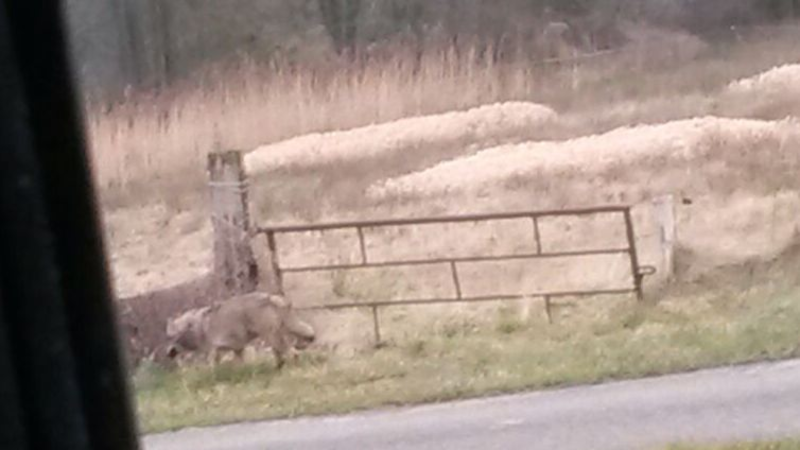
Wolf of Noord-Sleen, photographed from a car

Translated from NOS TV in the Netherlands today:

The wolf is back in the Netherlands, says the foundation Wolves in the Netherlands. This morning the animal was spotted and photographed near Noord-Sleen, in the province of Drenthe. According to wolves expert Leo Linnartz there is no doubt. “It’s the same wolf as the last days was seen near the border with Germany.”

German colleagues of Linnartz informed him in recent days that the wolf was on its way to the Netherlands. “It was no surprise that this morning we received the message that one was seen.”

Linnartz is sure that the photos he has seen are real. “There is no indication that the story is not true. It’s all very reliable,” he says.

See also here. And here. And here. And here.

This 5 March 2015 video shows a wolf in Germany…

View original post 115 more words

Wolf in the Netherlands was wild German wolf

petrel41's avatarDear Kitty. Some blog

This Dutch video is about Wolven in Nederland. This organisation prepares for when wolves will come back to the Netherlands, trying to prevent human-wolf conflicts.

Translated from the Wolven in Nederland site:

The wolf which wandered in early March through Drenthe and Groningen provinces comes from a pack of wild wolves in Germany. It is a young animal from the “Munster” pack in the region of Hamburg-Bremen. This is shown by DNA analysis.

Early this month, the Netherlands was fascinated by a wolf of unknown origin, which for a few days ran through Drenthe and Groningen. The animal appeared regularly and behaved not exactly in a shy way. Research shows that it nevertheless was a wild wolf.

View original post 33 more words

European toad winking its eye, video