This all-Indian puppy — we believe he’s been given the name, Knight — about to go home with his delighted family — was one of many adopted at the most recent adoption event of Blue Cross of India, in Chennai, this past Sunday, December 11th.
To visit the Facebook page of Blue Cross of India, click here.
The Egyptian Society of Animal Friends in Cairo, Egypt, continues to provide treatment and feeding seven days a week for the horses, camels and donkeys at the Pyramids. Because of the scarcity of tourists since the protests began early in 2011, the animals have been relying on help from ESAF and other groups for feed and vet care, since without income, their owners cannot care for them adequately.
From November 26 – December 12, ESAF fed 914 animals and gave vet care to 493.
An educational presentation by ESAF in Cairo, Egypt
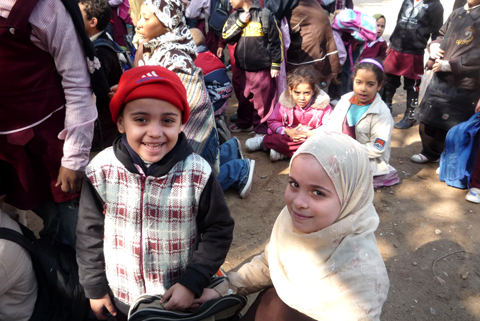
“As part of our educational program and part of the long term plan, ESAF in cooperation with Giza vet department made the first school visit at Abu El Hool (Sphinx) elementary school where the children, were instructed in the correct care of horses and camels and general animal welfare. A Donkey was used as part of the program; the children were very happy and attentive.” Ahmed El Sherbiny, Chairman of ESAF. In the new year ESAF will be taking this program to six more schools.
The University Grants Commission, New Delhi has issued official Guidelines for phasing out dissection and animal experimentation in Life Sciences studies in Indian colleges and universities.
The Guidelines state that dissection has been part of the curriculum in India for 90 years, but that now many technologies are available that make dissection outmoded.
In the past, there were fewer colleges and fewer students, so fewer animals were used. Now nearly a million students are enrolled in courses requiring dissection. The animals used, for the most part, are wild-caught, and this means that they are being removed from their natural habitats, disrupting biodiversity and the ecological balance. Dissection is now a factor, along with pollution, loss of habitat, and climate change in depleting wildlife populations – especially endangered and threatened species.
The decline in the frog population has reached alarming proportions – and frogs, as we know, are declining worldwide.
These recommendations in the Guidelines, both short-term and long-term, are intended to be a roadmap for revamping the curricula of science courses. They have been approved by the University Grants Commission and the Ministry of Human Resource Development. All university and college courses relating to animals will fall under these Guidelines. Here are some of the highlights, paraphrased, contained in the Guidelines.
Recommendation Number One:
To become effective immediately: “All Institutions of Higher Education [are] to strictly adhere to the Wildlife Protection Act, 1972, and the Prevention of Cruelty to Animals Act, 1960.”
The Indian Constitution, which is unique in the world in including animal protection and the natural world, states: “It shall be the duty of every citizen of India to protect and improve the natural environment including forests, lakes, rivers, and wildlife and to have compassion for all living creatures.”
The Prevention of Cruelty to Animals Act, 1960, requires that animal experiments be replaced, wherever possible, with suitable alternatives. It also stipulates that animal dissection should not be used for the purpose of improving manual skills.
The Wildlife Protection Act, 1972, protects all sharks and rays and all frogs of the genus Rana, which, generally speaking, means true frogs – not toads or other frog-like species.
Universities will now also be required to include a course on “animal ethics”. Excerpts of these two laws are to be posted in laboratories and classrooms.
Recommendation Number Two:
Every educational institution will have to set up a Dissection Monitoring Committee to review the use of animals in dissection, within the framework of the Guidelines, to ensure that animals are acquired from ethical sources, not from the wild, and that they are transported without experiencing stress or strain – or, if they are to be dissected, that they are anesthetized humanely. Good records must be kept.
A Rock Pigeon from Kolkata, West Bengale
Recommendation Number Three:
Numbers of animals used in experiments shall be reduced, and insofar as possible, must be obtained from breeders, approved by the CPCSEA. The idea behind this is not to imply that animals bred for laboratory use suffer less than wild animals; it is rather to regulate the use of animals with a view to phasing out animal experimentation in schools altogether.
Recommendation Number Four:
Only one species will be used for demonstration by instructors. Students will learn by observing and recording, not by performing dissections themselves.
It is suggested that instead of dissections, alternatives be used, such as pre-existing museum specimens, or photos, videos, models, charts, and field observations. In this way the animals can be studied without harming them. Field trips may be taken on the college campus and nearby habitats to familiarize students with local fauna.
When students go on field trips, they will only observe and record the animals –which will not be killed or removed from their natural habitat. The students will be told about conservation and biodiversity.
While undergraduate students will not normally do dissections; graduate students will be given a choice to perform dissection or to do a project related to biodiversity. If the students do choose dissection, they will use only selected species, perhaps one invertebrate and one vertebrate species. Computer simulation will be encouraged.
Students who opt for carrying out a project rather than doing dissection will be assisted with all necessary computer and digital tools and/or field trips and will be tested in an appropriate way.
Long-term actions:
Three to five day workshops will be held, with the help of organizations experienced in the field, to train teachers in the many computer-based alternate methods now available to replace the use of animals.
New software specifically geared to India will be developed and offered at no cost to universities.
Evolution, population dynamics and biodiversity will be emphasized in Life Science courses. The University Grants Commission will develop a model curriculum to serve as an example.
A remarkable breakthrough
This transition to using alternatives — computer programs and other modern technology to replace the dissection of animals will save the lives of millions of animals who would otherwise suffer. This major step sets an example for other nations to follow.
At a time when the natural world is under profound attack from a number of man-made causes, this is a very promising breakthrough.
We look forward to its speedy implementation and to the day when no animals – either bred – or wild-caught – will be used either for dissection or in any experiments.
A Cottontail in Montana, U.S.
When we as humans can relate to the natural world with respect and appreciation, it will be a brighter day for all of us.
For 42 years the CPCSEA (Committee for the Purpose of Control and Supervision of Experiments on Animals) has been fighting for the elimination of testing on animals and dissection in schools. Schools and universities are a good place to start phasing out the use of lab animals since they set the norms that students will adhere to in their future careers, and also one can make the clear point that dissection in schools is repetitive and unnecessary.
In 1968, the CPCSEA first put forward many of the recommendations that have just been issued in the Guidelines. They have worked hard since that time to have these measures officially adopted.
Dr. Chinny Krishna, who has served for many years on the Board of the CPCSEA, says, “These guidelines are the culmination of the efforts of Mrs. Maneka Gandhi who was Chairman of the CPCSEA from 1996 to 2002. Even earlier, there were attempts by People for Animals to discourage dissection and much earlier, starting in 1964, by the Blue Cross of India and the Bombay Humanitarian League. After giving up the Chair at the CPCSEA, Mrs. Gandhi kept after the UGC to stop dissection and, about three years ago, got a team consisting of Dr. Shiranee Periera, Dr. Sultan Ismail and myself to draw up a proposal towards this. The UGS guidelines are a result of one person’s dogged follow up, and Maneka Gandhi deserves full credit for this remarkable achievement”.
In 1987, the Blue Cross of India brought out its first interactive dissection software, COMPUFROG, followed by five more on the rat, pigeon, cockroach, rabbit and worm. The dynamic and effective group, Interniche, headed by Nick Jukes, which is active worldwide, has done very remarkable work in recent years to promote the use of alternatives to animal use in experimentation and dissection. The Blue Cross’ software finds mention in the list prepared by Interniche in their first book “From Guinea Pig to Computer Mouse”.
Top photo: This work has been released into the public domain by its author, LiquidGhoul. This applies worldwide. / Wikimedia Commons
Second photo: J.M. Garg / GNU Free Documentation License, Version 1.2 / Wikimedia Commons
Third photo: Larry D. Moore / GNU Free Documentation License, Version 1.2 / Wikimedia Commons
How to give to Blue Cross’s program to spay/neuter dogs and cats
To make a special donation to Blue Cross of India – through the program Global Giving — to get 500 animals spayed/neutered, click here.
Blue Cross must get at least 50 donors through this program before December 31, so donating even a small amount will help a lot!
To visit the website of Blue Cross of India, click here.
The last two months has witnessed far too many arrivals of Olive Ridley turtles on the shores of Mumbai. Two of them have been admitted in serious condition at Thane SPCA. Both were severely mauled …leading us to believe that they might have been victims of black magic. We had our third visitor four days back. By far the largest one admitted ( 70 kilograms, 154 pounds), and comparatively the healthiest with only some light bruises on his shoulder; Olio stayed with us for some light medication and dressing. Due to severe shortage of space we had to keep her – yet again – in a 500 litre Sintex tank, used previously by her fellow species patients, Oliver and Olivia. In four days her wound almost disappeared, and she was ready for release. During her stay our staff sourced sea water from the local creek in plastic bins, 120 litres at a time every day, to ensure that she was submerged in saline water throughout.
Prior to release our surgeon, Dr. Kiran Shellar, wanted to be sure about her swimming ability, something that has been in his mind since the rescue as to why Olio was washed ashore in the first place. Since there was no way she could swim around in the tank, we searched for two days for a children’s pool or someone’s bathtub, till we realised our member Yatin Mhatre had a small pool in his house where we could test her swimming.
Olio was carried from the hospital to Mr. Mhatre’s home, where she showed our surgeon and the Forest officials present, what a champion swimmer she is. Now she was ready to go back home.
Here was the most difficult situation facing us. Being a Schedule I species, we needed to co-ordinate with the Forest Department to be present during the release, and the Police for crowd management as well as allowing us entry into any high security areas. Choosing the spot for the release entails thorough research. The mode of transportation and time of release is of vital importance.
A persistent supporter of our work, Mili Gandhi, with her indomitable enthusiasm and knowledge of animals, did all the spade work. Through her we came to know of Mr. Viraf, who as a member of the Yacht Club, arranged for a sail boat, since a motor boat would make too much noise which would disturb the animal. Mr. Viraf and his friend were kind enough to let us use two of the boats. Mili and Viraf made detailed studies of the exact location for the release where the sea would be at its deepest and which is not frequented by fishing trawlers or fishing boats. The team which was on standby to go out was instructed on the dress code and other essentials.
Olive Ridleys nesting on the beach at Oxaca, Mexico
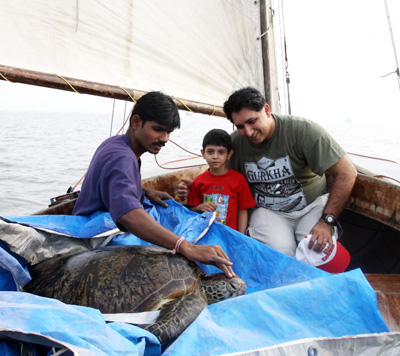
On November 24, 2011 our ambulance reached the gateway of India at 3 PM. It was carrying Olio in a Sintex tank filled with saline water. When we arrived, we contacted the Police officials stationed there for help. Immediately they deputed a large group to stand around the ambulance till Olio was ready to be shifted. At 3:30 PM, as the winds became favourable, she was shifted from the tank onto a blue tarpauline and with the help of the Forest officials, our staff, and some tourists she was carried to the boat. We had to change boats a little further on. Alan and Debashish did the photography from the second boat, while the rest were with Olio in the first boat for the release.
Olio was a little restless while in the ambulance (she traveled over 100 kilometers, 62 miles, from our hospital in Thane to Gateway of India ) and while being carried to the boat. But Mr. Viraf writes to us : ” Olive was frisky initially, but once we set sail he was as calm as the winds. We opened up the sheets and he (or she) was at complete ease in the boat and would occasionally stretch his neck high and eyes wide open, as I am sure the feeling of the sea breeze made him feel at home. ”
It took the team 50 minutes to reach the spot of release. As our hospital helper Vijay opened up the wraps of the tarpauline, Olio dove straight into the sea, bobbed up once, looked around and disappeared forever.
We would like to especially thank the Yacht Club for allowing us to use their sail boats, Mr. Viraf for the smooth co-ordination of the release, Alan and Debashish for their photography and videography, The Mumbai Police not just for providing us Security, but also for treating us to hot tea when we most needed it, the Range Forest Department, Thane and Range Forest officer Shri Singh, Mr. Mhatre for keeping vigil on Olio for a day and night by her side at the pool, Mili Gandhi for letting us exploit her time and brain and last but not the least Thane SPCA staff members who fed the Ridley with their own hands, hauled saline water physically from the sea and took turns to keep her moist for four days without a break.
After all this, Olio owes us hundreds of babies somewhere and to be smart not to get caught or washed ashore again.
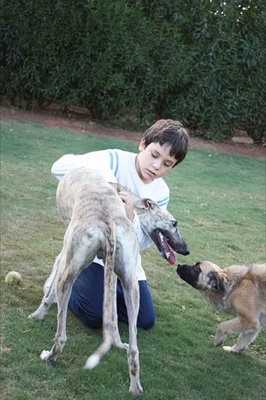
“Ten months after having been rescued from a terrible situation near Seville, Spain, MaKus is being adopted!” writes Barbara LeFranc of “Le Bulletin des Levriers”*
*A “levrier” is a Spanish greyhound.
To visit the website of “Le Bulletin des Levriers”, in French, click here.





 Art, animals, and the earth