Poet, writer, and advocate for wildlife, wild lands, and the earth. President, Forest Voices of India - a U.S.-based group which aids charities in India that further education, culture, the well-being of women, children, and animals, and the restoration of sacred groves.
websites:
https://wordpress.com/view/forestvoicesofindia.com
https://wordpress.com/view/echoesinthemist.com
https://wordpress.com/view/wildvoices.world
book: Glimpses of Kanchi
https://www.amazon.com/Glimpses-Kanchi-Sharon-St-Joan/dp/1982901179/ref=sr_1_1?keywords=Glimpses+of+Kanchi&qid=1581769003&sr=8-1
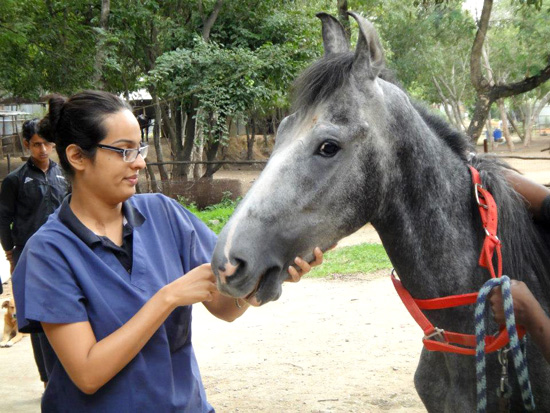
On August 18, 2012, Dr. Akruti Choksi donated an entire day of her expert services as an equine dentist to assist the horses being cared for by Samabhava, in Bangalore. She also donated her time earlier this year in March.
A horse’s teeth affect the entire health of the horse, so dentals are really important for overall good health.
Samabhava provides vet care to many working horses and gives shelter, along with good food and care, to several rescued horses.
On August 30, 2012, the New Zealand Herald, in an article by Kate Shuttleworth, reported that the Whanganui River has been granted legal status. This is believed to be the first time anywhere in the world that a river has been given such status. The iwi, who are Maori people, have signed an agreement with the government, which recognizes the river legally as a person.
According to a Wikipedia article, the word “iwi” does not really mean “tribe,” its meaning is closer to “people,” and it refers to the social structure of the Maoris.
The Whanganui River, New Zealand’s third longest river, runs for 180 miles (290 kilometers) through the North Island. The river has 200 rapids and is much appreciated by tourists for its white water.
Before the arrival of Europeans, many Maori villages were, and still are, located along the river, which has always held special importance for the Maori people. The Whanganui River iwi (the native people) have been in negotiations related to the river since 1873, seeking both their own rights and protection for the river. Further details in the agreement are still to be worked out.
The principle agreed to is that the river is, in the eyes of the law, a legal person and will be represented in the future by two guardians, one from the iwi people and one from the government.
This development could set a precedent for establishing the “personhood” of natural entities in other countries, and that, clearly, would put efforts to protect them on a sounder footing.
Traditionally, in many countries, and perhaps in some way for many people in all countries, rivers and mountains are often thought of as having a spirit or a presence, as being a “person.”
Photo: James Shook / Wikimedia Commons / This file is licensed under the Creative Commons Attribution 2.5 Generic license. / Whanganui River
To read the article in the New Zealand Herald, click here.
By: John C. Horning, Executive Director, WildEarth Guardians
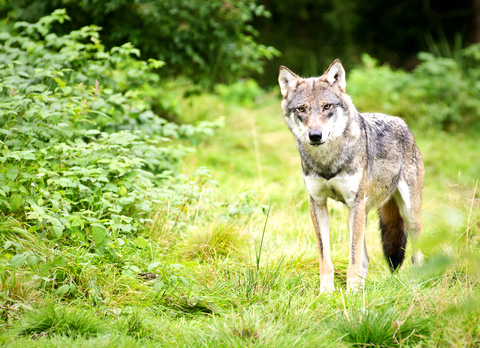
On September 10, 2012, WildEarth Guardians and partners filed papers initiating our lawsuit to overturn a decision by the U.S. Fish and Wildlife Service to remove wolves in Wyoming from the Endangered Species Act.
It’s the last option we have to prevent the slaughter of Wyoming’s wolves. Please support our Wolf Legal Defense Fund (see the link below) to help us stop the killing.
If the Service’s decision is allowed to stand, people in Wyoming could trap, hunt, bait and pursue wolves to their death throughout most of the state. And it all starts in a few weeks.
We simply can’t allow this to happen. We need to reverse the decision and return wolves in Wyoming to federal protection. Your support of our Wolf Legal Defense Fund will enable us to take swift and strong action to save wolves.
The Wyoming “wolf elimination plan” allows wolf killing every day of the year in over 80 percent of the state. Many of Wyoming’s current population of approximately 330 wolves will die this winter unless we strike down this plan.
The state intends to allow only 100 wolves to survive outside of Yellowstone National Park and the Wind River Reservation, but it has no way of tracking wolf numbers.
Wyoming’s wolf plan is driven by politics, not science. Interior Secretary Ken Salazar approved the plan to appease his friends in the Congressional Cowboy Caucus.
It’s not about livestock. Less than one half of one percent of livestock are killed by wolves.
It’s not about hunting elk. Wyoming’s elk population is 24 percent over its objective of 85,000 animals. The 2010 count reported 104,000 elk in the state.
It’s about intolerance and hate.
We must stand up to a small minority that want to eliminate wolves. We must ensure that an ethic of compassion and coexistence ultimately prevails. Our first step is to defend these beautiful animals in the court of law and in the court of public opinion.
Please help us prevent the Wyoming wolf slaughter by supporting our Wolf Legal Defense Fund today.
To bring out the bond that exists naturally between animals and children, Animal Equality India has been holding events in which children interact with all kinds of animals, including those that may be exploited for food, clothing, or as working animals.
Learning to appreciate chickens, rabbits, goats, pigeons, donkeys, dogs, and cats as real living beings opens the children’s eyes to an understanding that they have feelings just as humans do. The children gave some of the animals names; the pigeon was named Bebo, and the rabbit Caramel, the calf Choco, and the donkey Starsky.
On May 22, 2012, “Seeds of Compassion” started with a group of just 30 children, but these are 30 children that, for the rest of their lives, will be open to seeing animals as fellow beings on this earth.
Photo: Courtesy of Kartik Rathod and Animal Equality India
To visit the Facebook page of Animal Equality India, click here.
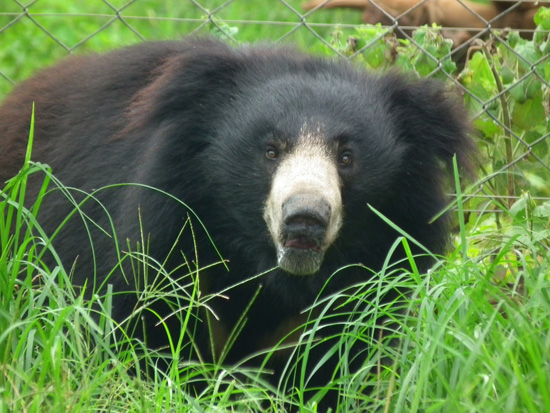
During the monsoon, Jambavant can be found after a heavy downpour, walking along with the mud squishing between his toes. He peers at the ground, waiting for bugs and termites to come up to the surface, and ants too! He enjoys having his fur all wet. For him the Agra Bear Rescue Facility, run by Wildlife SOS, is heaven.
It’s been five years since he arrived; his life in the past wasn’t much fun and, as a captive bear, forced to “dance” on the streets for money, he didn’t see much natural ground, muddy or otherwise, just hot sidewalks and long hours.
When he arrived, he was skinny, with a scrawny neck, and his fur falling out, but he’d come to the right place. With treatment from a caring vet and attentive caregivers, his appetite and his love of life bounced back. He got a lot of treatments, including a vaccination against Leptospirosis and deworming. He was named after Jumbavant, who was king of the bears in the epic Indian poem, the Ramayana.
Now Jumbavant is 13, and as he’s gotten a little older, tonics and calcium supplements help keep him spritely. He weighs 110 kilos (242 pounds), which is much better than being skinny.
In the early summer, before the rains come, when it’s hot and the sun streams down, Jumbavant likes to sleep inside most of the day. In the afternoons he comes out to have a nap under the shade of the climbing platform.
But later on in the season when the rains have arrived, he springs to life and plays with his pals, Nathan and Bhola. They climb as high as they can, taking turns being “king of the mountain” at the top of the platform.
Once the three of them played at climbing into a small hammock all at the same time, but their worried keeper was afraid they would end up in a heap with the collapsed hammock on top of them, so he distracted them with watermelon treats, and no harm was done to the bears or the hammock.
Mangoes are not always in season, but they are a special favorite, so when they are available, the bears enjoy stuffing themselves – and occasionally almost have a riot, stealing each others mangoes. Jambavant licks his plate very thoroughly, expecting that this will cause more mangoes to appear on the plate.
His enjoyment of life is contagious and makes everyone around him happy — and thankful that Jambavant has been given the gift of a joyful life.
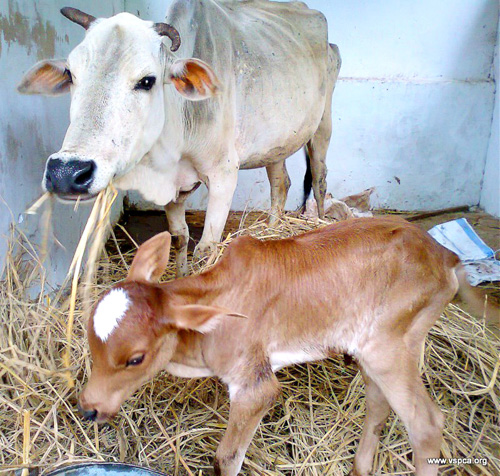
When 54 rescued cows first arrived at the VSPCA, they drank liters and liters of water before even touching their food. They are now recovering from malnutrition, dehydration, and wounds.
They were rescued from a lorry transporting them illegally to slaughter.
On August 5, at Marikavalasa village, near Visakhapatnam, Andhra Pradesh, workers from the VSPCA (Visakha Society for the Protection and Care of Animals) Shelter encountered the lorry filled with cows, just four miles from the shelter. They had spotted some of the heads of the cows at the very top. The cows were in deplorable condition.
The driver fled, and, with the assistance of the police, VSPCA shelter managers B. Sarada and Raj, were able to rescue all the cows, taking them to the VSPCA shelter.
Happily, one of the cows, who was about to give birth, now has a healthy, adorable, newborn calf. Mother and baby are both doing fine, and will be able to live out their lives at the shelter.
The VSPCA shelter cares for 1500 animals, including many rescued cattle, with the cows and bulls living separately. Every animal is valued and well-cared for. VSPCA’s ABC (spay-neuter) programs have also helped tens of thousands of community dogs in Visakhapatnam and surrounding areas.





 Art, animals, and the earth