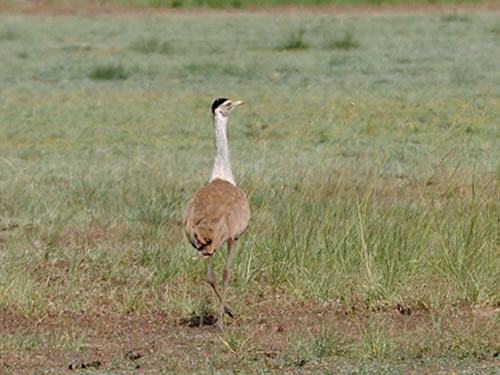
Captive breeding not the best option for endangered species

Captive breeding not the best option for endangered species

wildlifenewsuk's avatarWildlife News

http://wildlifenews.co.uk/wp-content/uploads/2015/06/indian-bustard-400×300.jpg – A new study has been published in the Journal of Applied Ecology by researchers at University of East Anglia (UEA) that shows captive breeding should not be the first option when trying to protect endangered species. A captive breeding programme may appear to be a good option but letting … – http://wildlifenews.co.uk/2015/06/captive-breeding-not-the-best-option-for-endangered-species/

View original post

African Wildlife Foundation commends Kenya for ‘whole-of-government’ investigation leading to high-level arrests

African Wildlife Foundation commends Kenya for ‘whole-of-government’ investigation leading to high-level arrests

wildlifenewsuk's avatarWildlife News

http://wildlifenews.co.uk/wp-content/uploads/2014/12/baby-elephant-400×300.jpg – Police in Kenya have arrested several people in connection with two caches of illegal ivory seized in Thailand and Singapore respectively. Abdurahman Mohammed Sheikh, a tycoon living in Mombassa, Kenya, and his two sons were taken into custody for their alleged involvement in illegally shipping i… – http://wildlifenews.co.uk/2015/06/african-wildlife-foundation-commends-kenya-for-whole-of-government-investigation-leading-to-high-level-arrests/

View original post

The Indonesian Forests May Breathe Now

Organikos's avatarOrganikos

Loss of forest habitat through pulp and paper logging and palm oil plantations has pushed endangered species such as the Sumatran tiger, rhinoceros, elephants and the orangutan closer to extinction. PHOTO: Greenpeace Loss of forest habitat through pulp and paper logging and palm oil plantations has pushed endangered species such as the Sumatran tiger, rhinoceros, elephants and the orangutan closer to extinction. PHOTO: Greenpeace

Indonesia has the third largest tropical rainforest in the world. The country is also the world’s largest producer of palm oil, fifth largest of coal, and tenth largest producer of pulp and paper. To say these industries are tied to resources of the land is to state the obvious. But to say that the activities are fast eating into forest cover is a matter of concern. Which is precisely why when a company like Asia Pacific Resources International Limited (APRIL) – the country’s second largest paper and pulp company – announces that it will completely eliminate deforestation in its operations, the world takes notice.

Greenpeace Australia Pacific said the “good news” came after more than 40,000 Australians emailed Australian paper…

View original post 268 more words

Lufthansa joins the hunting trophy ban

Lufthansa joins the hunting trophy ban

wildlifenewsuk's avatarWildlife News

http://wildlifenews.co.uk/wp-content/uploads/2015/06/lufthansa-400×300.jpg – Lufthansa Cargo has become the latest airline to ban the carriage of hunting trophies from Africa. The company has confirmed that it will no longer carry any trophies of the African fauna such as lions, elephants and rhinos even from countries where hunting is legal.
The company is now the third … – http://wildlifenews.co.uk/2015/06/lufthansa-joins-the-hunting-trophy-ban/

View original post

Four global airlines say no to hunt trophies

Four global airlines say no to hunt trophies

wildlifenewsuk's avatarWildlife News

http://wildlifenews.co.uk/wp-content/uploads/2015/06/singapore-airlines-400×300.jpg – Four global airlines are saying no to hunt trophies as a momentum starts to build. Singapore Airlines have had a ban on all hunt trophies in place since 19th May 2015.
Together with the three other airlines ? South African Airways, Emirates and Luftahansa ? passengers who want to fly… – http://wildlifenews.co.uk/2015/06/four-global-airlines-say-no-to-hunt-trophies/

View original post

Good Siberian tiger news

petrel41's avatarDear Kitty. Some blog

This video says about itself:

Siberian tigress Ilona captured on camera a year after release – Part II

28 May 2015

Raw footage taken by a camera trap inside Khingan Nature Reserve in Far East Russia that shows Ilona the Siberian tigress marking her territory. Ilona is one of five orphan tigers that IFAW helped rehabilitate and release back to the wild in May of 2014. A drop-off satellite collar fitted on Ilona provides scientists with critical data to better protect the species. There are less than 400 wild Siberian (aka Amur) tigers left in the wild. To find out more, visit: www.ifaw.org.

From Wildlife Extra:

12 month’s after release ‘Putin’s tigers’ are reported as thriving

One year after five orphaned Siberian tigers were released in the Russian Far East the signs are four out of the five are doing well and have adapted successfully to life in…

View original post 365 more words

Be for Boreal Forests

Organikos's avatarOrganikos

Canada’s boreal region covers almost 60 percent of the country’s land area, essentially spanning from the Atlantic to the Pacific. It is one of the largest and most complex ecosystems on the planet. PHOTO: borealfacts.com Canada’s boreal region covers almost 60 percent of the country’s land area, essentially spanning from the Atlantic to the Pacific. It is one of the largest ecosystems on the planet. PHOTO: borealfacts.com

Question time. What is the largest intact forest on the planet? If you guessed Amazon, firstly you aren’t the only one; more importantly, you’ll have to know the answer is the Canadian boreal forests. Here are some facts: It covers a staggering 1.5 billion acres, between 1-3 billion birds flock nest and breed here each year, it alone stores 208 billion tonnes of carbon i.e 20 years worth of the world’s emissions from burning fossil fuels, and contains 200 million acres of surface fresh water alone. Yes, that’s a lot of numbers; but they are only some of the reasons for making sure these forests stay intact.

So, whether you enjoy a morning chasing warblers in Central…

View original post 172 more words

Meet the ‘Water Man’ of India

Organikos's avatarOrganikos

The 2015 Stockholm Water Prize has been awarded to Rajendra Singh for his consistent attempts to improve the country's water security  PHOTO: SIWI The 2015 Stockholm Water Prize has been awarded to Rajendra Singh for his consistent attempts to improve the country’s water security PHOTO: SIWI

Twenty years ago, when 28-year-old Rajendra Singh arrived in an arid village in Rajasthan, he came with degrees in Ayurveda and Hindi and a plan to set up clinics. That’s when he was told the greatest need was not medical help but clean drinking water. Groundwater had been sucked dry by farmers, and as water disappeared, crops failed, rivers, forests and wildlife disappeared and people left for the towns. In 2008, The Guardian listed him as one of its “50 people who could save the planet”. In March 2015, he was awarded the Stockholm Water Prize, known as the Nobel Prize for water.

View original post 78 more words

France passed law making rooftop solar or gardens mandatory on new commercial buildings

Robert A. Vella's avatarThe Secular Jurist

Two months ago, France passed a law that requires the rooftops of new commercial buildings to be partially (at least) covered by solar panels or plants. The law, passed back in March, was a compromise with French environmentalists and more conservative* members of society.

Continue reading:  http://www.dailykos.com/story/2015/05/27/1388257/-France-passed-law-making-rooftop-solar-or-gardens-mandatory-on-new-commercial-buildings#

Related story:  California’s largest lake is slipping away amid an epic drought

View original post