Author: sharonstjoan
Poet, writer, and advocate for wildlife, wild lands, and the earth. President, Forest Voices of India - a U.S.-based group which aids charities in India that further education, culture, the well-being of women, children, and animals, and the restoration of sacred groves.
websites:
https://wordpress.com/view/forestvoicesofindia.com
https://wordpress.com/view/echoesinthemist.com
https://wordpress.com/view/wildvoices.world
book: Glimpses of Kanchi
https://www.amazon.com/Glimpses-Kanchi-Sharon-St-Joan/dp/1982901179/ref=sr_1_1?keywords=Glimpses+of+Kanchi&qid=1581769003&sr=8-1
The Indian Wolf Population is on the Decline and It’s a BIG Mistake!

First posted on Bodahub, http://bodahub.com/indian-wolf-population-on-the-decline/#more-4272
By the Bodahub staff
Wolf and man have a millennia-old relationship. They gave us our best friend, the whole culture of the werewolves, and fascinating fare for movies and books.
But now, the wolf population in India is on the decline, and we may be causing widespread damage to the environment. Luckily we may have other countries to learn from.
The Assault on the Indian Wolf
The wolf population is under severe strain in India. Shortages in zoos have led to a brisk exchange program and put pressure on the endangered animals. The Indian wolf can only be found in the wild in two states: Gujarat and Rajasthan.
The Jodhpur Zoo recently offered a pair of lions in exchange for a pair of wolves from the Shakkarbagh Zoo in Gujarat. The female of the wolf pair is yet to be delivered. When the Shakkarbagh Zoo was keen on acquiring a pair of tigers from Bangalore, they were asked for a pair of wolves in exchange.
The need has created pressure on the wild population, which is already under severe duress. There are an estimated 250 wolves in Gujarat and around 300 in Rajasthan. The Gujarat authorities have set up artificial breeding centres to attempt to revive the population.
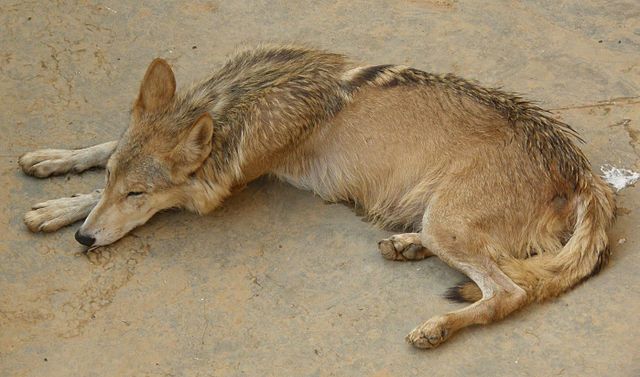
Local farmers consider the wolf a threat to their livestock and do not hesitate to chase them out of their fields or kill them by smoking out their dens. Sometimes, mothers are killed, leaving young cubs behind that cannot fend for themselves. More damage is caused by wild lands being converted to farms, and reduced food sources. Wolves like solitary places and cannot tolerate the human presence. And no, we don’t own the planet…
The larger worry though is that wolves play a very important role in the maintenance of the ecosystem. Wolves prey primarily on large ungulates, hoofed mammals. By preying on the most vulnerable (diseased, young, old, weak or injured) individuals, wolves help keep prey populations healthier and more vigorous. Predation by wolves also regulates ungulate distribution and group size, which impact overall native biodiversity.
When the ungulate population becomes too abundant for their habitat, for example, they overgraze vegetation, leading to habitat degradation and its incredibly damaging effects on other native wildlife.
Populations can be bred artificially, but need to be reintroduced to the wild. The effects of such experiments in the past were wildly successful and should be carefully considered by the Indian wildlife authorities.
The Yellowstone Park Experiment
When wolves were reintroduced into the Yellowstone National Park, within a short time, they managed to change the course of rivers and affect local and migratory wildlife in a positive way. In short, they completely changed the local ecology and environment – that would have otherwise taken decades of conservation efforts.
India could do well to learn from such efforts and emulate them. The effects of reintroducing wolves into the wild may not have the exact same extent of effects, but the benefits are undeniable.
But such a move needs to be supported by education, awareness, and compensatory mechanisms for the farmers when they, and their livestock, venture into a wolf’s territory.
India has seen a lot of success on that front in different wildlife preserves. Local populations that live on the borders of forests have shown sufficient understanding and are able to coexist with tigers, lions, and leopards.
The occasional loss of livestock is part of life and nature’s cycle. But it can be a win-win situation too. Local populations in the foothills of the Himalayas are now getting insurance from NGOs for snow leopard attacks on their livestock. The snow leopard is a critically endangered animal and conflict with humans is simply not acceptable.
However, there’s no reason why we need to wait for the wolf to become critically endangered too before we act, is there?
George Monbiot’s four minute video, How Wolves Change Rivers
https://www.youtube.com/watch?v=ysa5OBhXz-Q
A just transition to a world beyond coal
Reforesting the Amazon

 NEW VENTURE: Deniston Mariano Dutra and his son Matheus Correia Dutra harvest cacao seeds. After giving up on cattle, the family replanted their farm with these indigenous trees. © Kevin Arnold via TNC
We care deeply about Amazonia, and Brazil is the country with the most deforestation in the river region, specifically from cattle ranching. But good news is coming from The Nature Conservancy in the April/May issue, where, as the article’s subtitle reads, “After decades of turning forests into pastures and fields, Brazilian landowners have begun reversing the trend.” Julian Smith reports for the TNC Magazine:
Lazir Soares de Castro stands amid white and gray Nelore cattle on his ranch in São Félix do Xingu, a remote and sprawling county on Brazil’s northeastern Amazon frontier. Beyond a wooden fence, high grass and scrub brush fade into sporadic trees in the distance.
Still vital at 70, Soares describes…
View original post 935 more words
London bird news today

This video from England says about itself:
18 January 2013
Highlights in London Wetland Centre‘s World Wetlands include Asian short-clawed otters, Hawaiian geese (Nenes) and White-faced whistling ducks. Filmed by Television Roehampton.
From the London Bird Club in England today, on Twitter:
London WWT: Snipe, 4 Common Tern, Common Sand[piper], Little Ringed Plover, 2 Shelduck, Grey Wagtail, 3 Wheatear.
Related articles


Climate Change Is Moving The North Pole

National Geographic reports on how climate change is moving the North Pole.
As melts and aquifers are drained, Earth’s distribution of mass is changing—and with the position of the planet’s spin axis.
Read story at Climate Change Is Moving the North Pole
Common merganser video
This is a common merganser video, which also shows some smews and mute swans. Winter 2015-2016. Belarus.
Related articles


A baby monkey’s sad story takes a brighter turn

 Dawn Williams with little Lallu
By Rudra Krishna
First published by http://bodahub.com
The Blue Cross of India is an NGO and Animal Welfare Organisation situated in Chennai (Madras) in the South of India. I must begin with the disclaimer that I have been a volunteer with this over-50 year old organisation for most of my life.
The Head of Rescues in the Blue Cross of India is Dawn William, a former army man, vegan, and animal rescue specialist par extraordinaire. I could have gone with one of his more action-filled rescues here, but I’ve chosen the current one to make a relevant point.
Approaching midday on the 31st of March, 2016, Dawn received a panicked call from a security officer in a factory on the outskirts of the city. The information given was that a dead monkey had been found on the premises. What caused the panic was that alongside…
View original post 496 more words
How clownfish live together peacefully
This video, recorded in India, says about itself:
21 August 2012
Symbiosis, including anemonefish & clownfish. Part 18 of my DVD, “Reef Life of the Andaman“.
From ScienceNews:
In the Coral Triangle, clownfish figured out how to share
by Sarah Zielinski
11:41am, April 1, 2016
Clownfish and anemones depend on one another. The stinging arms of the anemones provide clownfish with protection against predators. In return, the fish keep the anemone clean and provide nutrients, in the form of poop. Usually, several individual clownfish occupy a single anemone — a large and dominant female, an adult male and several subordinates — all from the same species. But with 28 species of clownfish and 10 species of anemone, there can be a lot of competition for who gets to occupy which anemone.
In the highly diverse waters of the Coral Triangle of Southeast Asia, however, clownfish…
View original post 426 more words
Two sperm whales saved from stranding
This 2 April 2016 video from Breskens in Zeeland province in the Netherlands shows a sperm whale swimming and blowing.
Translated from RTL TV in the Netherlands today:
Two sperm whales have been successfully returned to sea this morning, after they had been seen in the Westerschelde estuary between Vlissingen and Breskens.
Volunteers of the lifeboat organisation KNRM and Rijkswaterstaat with their boats made a funnel on the water so that the sperm whales could only swim towards the sea. “The operation was successful. The sperm whales are off Cadzand,” said a spokesperson for Rijkswaterstaat.
England: East coast sperm whales stranding investigation continues: here.
Related articles


View original post 31 more words
 Art, animals, and the earth