North Dakota Tramples Journalist Deia Schlosberg’s Constitutional Right to Cover Historic Climate Protests

robertscribbler's avatarrobertscribbler

“We already have five times as much oil and coal and gas on the books as any scientist thinks is safe to burn.” — Bill McKibben

*****

Deia Schlosberg seems to me to be an exceptionally responsible person. A producer of the Josh Fox film How to Let Go of the World and Love all the Things that Climate Can’t ChangeDeia has already helped thousands of people to more deeply understand the very serious risks associated with our continued burning of fossil fuels. To understand it on an intimate, personal level. And for this we owe her not only our gratitude, but the firm affirmation of our voices lifted to support her during her time of unjust persecution.
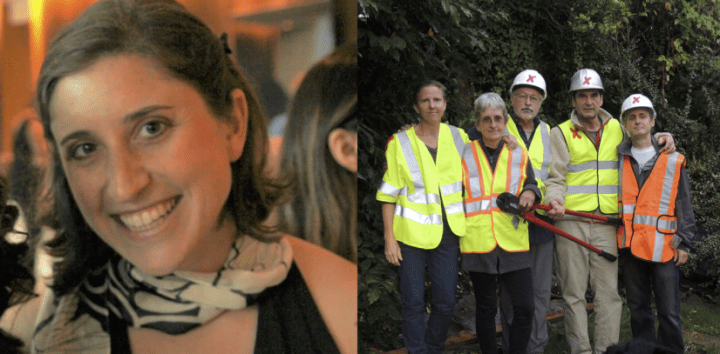
deia-schlosberg_climate-direction-action-activists

(Deia Schlosberg [left] and climate activists who briefly shut down TransCanada Tar Sands production on October 11 [right]. Image source: Desmogblog.)

For Deia appears to have earned herself…

View original post 1,431 more words

Birding from VdF: San José Estuary

Seth Inman's avatarOrganikos

Since last week, I’ve been based back at Villa del Faro in Baja California Sur, Mexico, where I’ll be co-managing the property with Jocelyn for a good while. In addition to having the opportunity to see what kind of birds show up here in their winter migration, I’m also hoping to have time to check out the surrounding region for other birding hotspots. I’ll do this not only for my own interest, but also because we may get guests here in the future who are bird-watchers.  I’d like to be able to recommend areas based on my own experience, so they don’t have to rely solely on eBird, which helps find certain spots but can’t give you any directions that Google Maps doesn’t have.

Nevertheless, eBird is one of the best ways to quickly figure out what locations within a region are popular for birding, whether because they have lots of…

View original post 200 more words

Beauty Is A Beast

Organikos's avatarOrganikos

3029 Culling could undermine the viability of the entire Norwegian wolf population, say conservationists. Photograph: Roger Strandli Berghagen

We love sheep, and sheep farmers, and shepherds, and wool, and so on. But we cannot read this without feeling more sympathy for the wolves, at this moment:

Norway’s wolf cull pits sheep farmers against conservationists

Norway’s recent decision to destroy 70% of its tiny endangered population of wolves shocked conservationists worldwide and saw 35,000 sign a local petition. But in a region dominated by sheep farming support for the cull runs deep

Elisabeth Ulven and Tone Sutterud in Oslo

Conservation groups worldwide were astonished to hear of the recent, unprecedented decision to destroy 70% of the Norway’s tiny and endangered population of 68 wolves, the biggest cull for almost a century.

View original post 211 more words

UK to ban fishing from a million square kilometres of ocean

Exposing the Big Game's avatarExposing the Big Game

https://www.theguardian.com/environment/2016/sep/15/uk-to-ban-fishing-from-a-million-square-kilometres-of-ocean

Government creates marine protected areas around four islands in the Pacific and Atlantic, with commercial fishing banned in some areas
One of the world’s biggest marine protected ares will be created around the Pitcairn Islands

Adam Vaughan
Thursday 15 September 2016 06.

In total, the government is creating marine protected areas around four islands in the Pacific and Atlantic, including the designation this week of one of the world’s biggest around the Pitcairn Islands.

A 840,000 sq km (320,000 sq mile) area around Pitcairn, where the mutineers of the Bounty settled, becomes a no-take zone for any fishing from this week. St Helena, around 445,000 sq km of the south Atlantic ocean and home to whale sharks and humpbacks, is now also designated as a protected area.

The foreign office said it would designate two further marine protection zones, one each around two south Altantic islands – Ascension by…

View original post 348 more words

Kingfisher, ducks, swan on Voorne island

Cost of Wind Energy to Decrease

Seth Inman's avatarOrganikos

Photo via Pinterest

With Deepwater Wind’s Block Island energy farm in Rhode Island completed – all five turbines of it – it’s not surprising to learn that the cost of wind power, just like that of solar, is going to decline in coming years, according to industry experts. Prachi Patel reports for Conservation Magazine:

Wind energy is soaring around the world thanks to technology advances and energy policies that have reduced its cost. And things are only going to get better with prices dropping substantially by mid-century, according to a survey of 163 of the world’s leading wind energy experts. The results, published in the journal Nature Energysuggest that the cost of electricity from wind could drop by 24–30 percent by 2030 relative to 2014 prices, and by 35–41 percent by 2050.

The key driver of this price drop? Bigger, more efficient turbines, according to the experts. Taller turbines with larger…

View original post 192 more words

Monkeying Around

Monkeying Around

Jocelyn Toll's avatarOrganikos

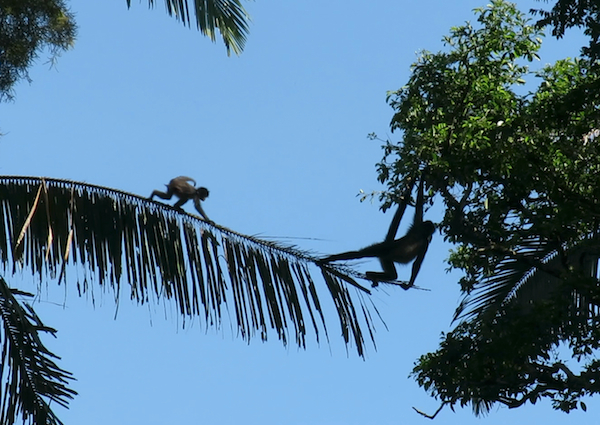
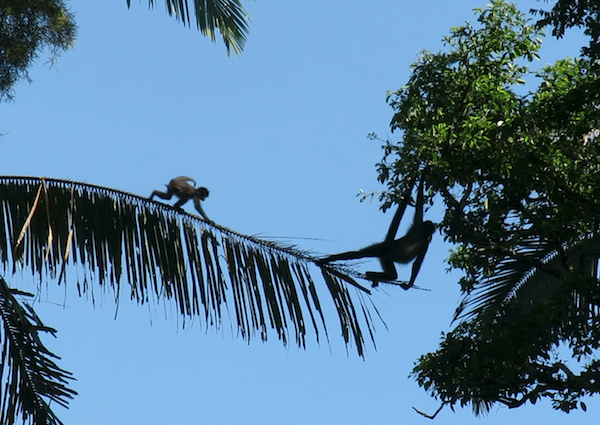
Photo by Seth Inman Photo by Seth Inman

Spider monkey encounters are commonplace at Chan Chich Lodge. Whether it be during an early morning bird walk or a late afternoon read on the porch futon, spider monkeys will likely make their swinging appearance from the tree top branches at some point during the day. They are curious, but daring creatures that will have no shame in shaking up a couple of branches above your head and letting fruits fall on you if they feel threatened (an inexplicable reaction in my mind when I humbly walk through the trails hoping to catch sight of a Tody Motmot).

Having been in Belize for over a month, I have several memorable anecdotes to share about spider monkeys, but I will share two that I believe encapsulate the magnificence of these intelligent creatures.

View original post 324 more words

Giraffes Are Not One But Four Different Species

Sandy Steinman's avatarNatural History Wanderings

The NY Times reported on the discovery that giraffes are not one but four very distinct speicies

“The genetic differences between giraffes is so large that we have to in fact describe four new species,” said Axel Janke, a geneticist from the Senckenberg Biodiversity and Climate Research Center in Frankfurt. “Some of the differences were as large or larger than the differences between brown bears and polar bears.”

Read story at A Quadruple Take on the Giraffe: There are Four Species, Not One – The New York Times

View original post