Amber discovery on Texel island beach

petrel41's avatarDear Kitty. Some blog

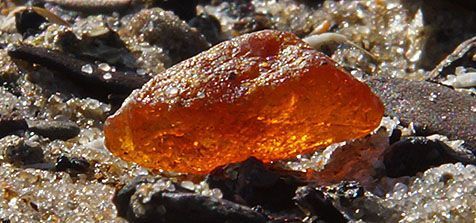
Amber, found on Texel beach by photographer Sytske Dijksen

Translated from Ecomare museum on Texel island in the Netherlands:

Ecomare on Thursday, April 30th, 2015

It is the dream of every beach walker: to find amber. Photographer Sytske Dijksen recently found dozens of pieces of amber on the southernmost point of the Hors peninsula on Texel. Amber is a precious gemstone. It is fossilized and petrified resin. There are a few other “stones” very similar to amber; both originated from resin. But those are not fossil and petrified. Most of the bits of ‘amber’ found in the Netherlands turn out to be not real. In this case, they are!

Real fossil

Amber is old. The pieces of amber that you find in the Netherlands come from the Baltic region and date back to the Eocene epoch, 35 million years ago. Then there were vast coniferous forests. The pine species delivering amber of the highest quality which people prefer…

View original post 20 more words

Tesla’s Powerwall Puts Huge Crack in Carbon-Based Energy Dominance

GarryRogers's avatarGarryRogers Nature Conservation

“I think we should collectively try to do this, and not win the Darwin Award.” — Elon Musk * * * * * This week, with much fanfare, Elon Musk’s Tesla launched a new venture — Tesla Energy….

Source: robertscribbler.wordpress.com

GR: Elon Musk and Pope Francis are battling global warming using technological and ethical strategies. From Robert Scribbler’s article about Musk’s “Powerwall”: “A low-cost, high quality offering that will allow individual and family solar users to say to hell with the grid, contentious fossil fuel interest muddied utility politics, and any coal or gas fired powerplants if they so choose.”

See on Scoop.itGarry Rogers Science Fiction

View original post

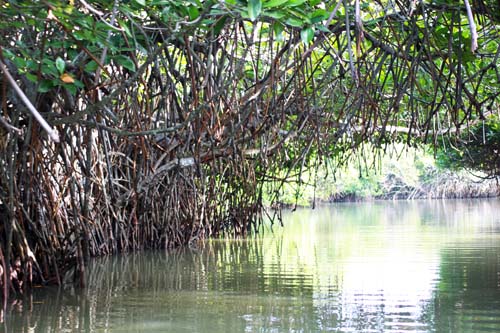
Pichavaram, the mangrove forest

sharonstjoan's avatarEchoes in the Mist

IMG_8069

By Sharon St Joan

The water is not deep at Pichavaram, maybe two or three feet. It is dark green. Waterways run between the islands of mangrove trees. Pichavaram lies along the coast of the Bay of Bengal, in south India.

In February, 2015, our rowboat sailed quietly along the waterways which came together, parted, divided again. The water rippled peacefully.

IMG_8084

Beautiful great egrets landed on the mangrove trees, taking off and circling, then returning. In the shadows, a little yellow bittern waited, perched on a mangrove root near the water’s edge, half-concealed behind the leaves and branches, watching hopefully for his dinner to swim by.

When cyclones come, the mangrove roots, which sink deep into the mud below the water, protect the mangrove forest from destruction and the land from erosion. Along one side, the mangrove trees of Pichavaram have been cleared to make way for grazing goats. This…

View original post 665 more words

Saving the sound of summer – Pollinating the Peak campaign launches

Saving the sound of summer – Pollinating the Peak campaign launches

wildlifenewsuk's avatarWildlife News

http://wildlifenews.co.uk/wp-content/uploads/2015/04/common-carder-bee-bombus-pascuorum-moors-for-the-future-partnership-small-400×300.jpg – A major Peak District-based campaign to help bumblebees launches today (Thursday 30 April 2015) with a unique Pollination Conference in Chesterfield and the arrival of a stunning bumblebee wood sculpture at the town’s world-famous Crooked Spire.
The three-year Pollinating the Peak initiative – ru… – http://wildlifenews.co.uk/2015/04/saving-the-sound-of-summer-pollinating-the-peak-campaign-launches/

View original post

Amazonian Tribes Unite To Demand Brazil Stop Hydroelectric Dams

Amazonian Tribes Unite To Demand Brazil Stop Hydroelectric Dams

Red Power Media, Staff's avatarRED POWER MEDIA

 Members of the Munduruku indigenous tribe dance along the Tapajós river during a ‘Caravan of Resistance’ protest in November. Photograph: Mario Tama/Getty Images Members of the Munduruku indigenous tribe dance along the Tapajós river during a ‘Caravan of Resistance’ protest in November. Photograph: Mario Tama/Getty Images

By Jonathan Watts | The Guardian

Four Amazonian tribes have joined forces to oppose the construction of hydroelectric dams in their territory as the Brazilian government ramps up efforts to exploit the power of rivers in the world’s biggest forest.

The Munduruku, Apiaká, Kayabi and Rikbaktsa released a joint statement on Thursday demanding the halt of construction on a cascade of four dams on the Teles Pires – a tributary of the Tapajós.

They say the work at the main area of concern – the São Manoel dam – threatens water quality and fish stocks. The site has already reportedly expanded almost to the edge of a nearby village, although the local communities say they have not been consulted as they obliged to be under national laws and international standards.

View original post 498 more words

Wild boar piglets, video

African-led Strategy, Action Plan to Combat Illegal Trade in Wild Fauna and Flora

African-led Strategy, Action Plan to Combat Illegal Trade in Wild Fauna and Flora

wildlifenewsuk's avatarWildlife News

http://wildlifenews.co.uk/wp-content/uploads/2015/04/Photo-credit-to-Daudi-Sumba_African-Wildlife-Foundation_RoC-ivory-burn-in-Brazza-400×300.jpg – Today, April 30, concludes the four-day International Conference on Illegal Trade in Wild Fauna and Flora in Africa in Brazzaville, Republic of Congo. The conference brought together regional and international stakeholders to develop an African-led strategy and action plan for combating the illeg… – http://wildlifenews.co.uk/2015/04/african-led-strategy-action-plan-to-combat-illegal-trade-in-wild-fauna-and-flora/

View original post